Showing posts with label news and commentary. Show all posts

Tuesday, May 22, 2018

The Whole World Has Gone After Him


The Whole World Has Gone After Him

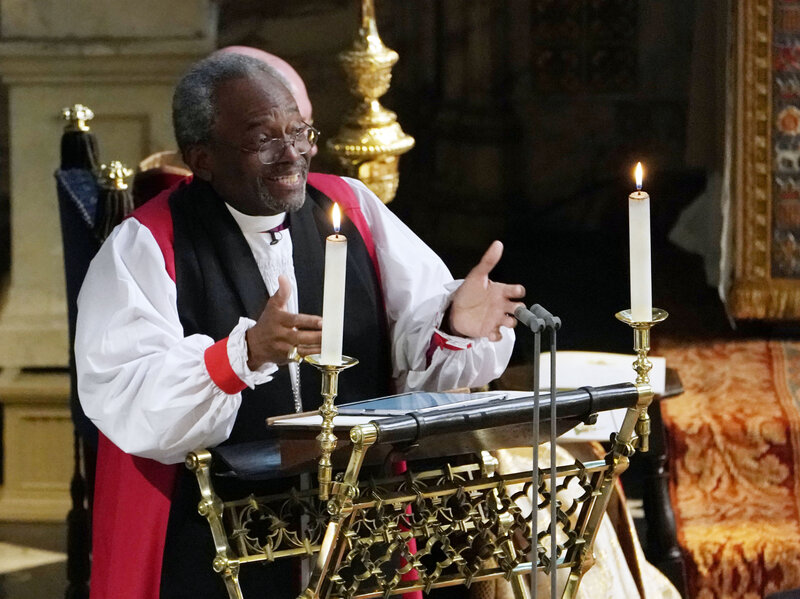
In response to Presiding Bishop Curry's sermon delivered at the Royal Wedding, some of the schismatics who are opposed to the Episcopal Church in general took a posture reminiscent of the Pharisees during Jesus' Triumphal Entry into Jerusalem: "They said to one another, 'This is getting us nowhere. See, the whole world is going after him,'" as though the fact that the world was so blessed and uplifted by the Episcopal Primate's hope-filled, winsome homily was a sign that there must be something wrong with it. A cheap gospel, they surmised. One post comment by an ACNA bishop called it an example of "Christianity Light" in contrast to their brand, "Christianity Max", as he referred to it. And here in South Carolina, where the Presiding Bishop is most welcome and visits frequently, we are accustomed to hearing from our former colleagues that "they (meaning we of the Episcopal Church South Carolina) ascribe to a 'different religion'". Isn't that what the threatened Pharisees are reported to have said of Jesus in John 12:29; that is, "the whole world has gone after Him."? 

For a sermon to have been so popular with such a wide range of people is not some automatic disqualifier, as the naysayers contend. The Royal Wedding sermon was authentically Christian. Its broad acceptance and glowingly positive reception by people of almost every stripe may simply be an indication  that the preacher wisely and lovingly took stock of the enormous opportunity that befell him. He preached the Good News  that God is for us and not against us on a global stage. He decided to eschew school-marmish, moralistic, pharisaical  religion in favor of the Good News that God hints to us through human love of a far deeper love still, one found in the sacrificial love of God in Jesus Christ. Contrary to the complaint of some naysayers, Bishop Curry went far beyond Cupid and Eros in the most gracious and pastoral way that the world has seen...well...quite possibly...ever in our lifetimes. He even suggested that with such godly love, we can change the world. (If THAT'S what the naysayers mean when they say that we ascribe to a different religion, then maybe they have a valid point.)

We who beam with joy at seeing the Archbishop of Canterbury and the Anglican Primate (Episcopal Presiding Bishop) of the United States standing together talking about an "unconventional Gospel- revolution of love" have been dismissed as those who have "itching ears", running after those who tell us only what we want to hear (II Timothy 4). My ears have indeed been itching. They have been itching for an encouraging word from a gifted preacher that everyone is created equal and is equally loved by the One who created us. Presiding Bishop Curry actually did what St. Paul enjoins us to do: "Preach the word; be prepared in season and out of season; correct, rebuke and encourage--with great patience and careful instruction." II Timothy 4:2 What we saw on Saturday in St. George's Chapel at Windsor was perhaps the most effectively evangelical use of 13 minutes the world has ever seen. Presiding Bishop Michael Bruce Curry did the work of an evangelist, par excellence.

Chris Huff
Priest in the Diocese of the Episcopal Church in South Carolina
Dean of the West Charleston Deanery

Be sure to check out my 10-part blog series entitled
"Why I Stayed (in the Episcopal Church)" 
See the side bar for easy access to it.

Monday, November 16, 2015

It's OK to Grieve for Paris

To Those Who Would Criticize Those Who Grieve for France

Yes, it is true that so far in 2015 there have been approximately 297 documented terror attacks around the world: In January-30,  in February-12, in March-22, April-20, May-27, June-30, July-40, August 32, September-16, October-48, and so far in November-20. In some of these attacks, only the perpetrator was killed or injured. Fatalities or injuries in other attacks ranged from one to over 2,000. Methods used were shellings, bombings (IED's as well as carbombs), suicide bombings, beheadings, stabbings,  arson,  shootings, poisonings, vehicular attacks and more.  Beirut, the West Bank, the Philippines, Copenhagen, the Ukraine, Chad, Nigeria, Cameroon, Egypt, Afghanistan, Pakistan, Turkey, Iraq, China, Saudi Arabia, Yemen and other countries and regions have been affected. Some by militant crazies, others by rogue governments, lone wolves and many by radical jihadist groups and individuals. People who more visibly grieve over the IS attacks in France have been criticized by some for singling out France while purportedly ignoring other victims of terror attacks. Let me offer some reasons why the attacks in France may resonate more with those of us in the Western World:
1) France was a champion of "Liberte'" with us when we were struggling for independence as a nation.
2) France, like the USA, strives to live openly (which involves risk).
3) Paris, for goodness' sake, is universally known as "the City of Love" 
4) France and other Western European countries, like the USA, emulate principles of equality, freedom of speech and, for the most part, elective forms of government.
5) IS, by attacking innocent ones in Paris, brings a realization that it seems NOT to be so well contained, and is edging closer to us.
So when Paris comes under terrorist attack, many of us feel it more intensely and identify with it more. Many of us have been to Paris, and so grieve for it with more poignancy.
Take care to allow people to relate and identify. It can be part of their awakening,  and can serve as a reminder of what has happened to us on our own soil as well, lest we lose our vigilance.
Then indeed, let us also understand that the many other innocent victims in the many other countries are also just as precious in God's sight.
The best thing we can do is pray, and pray for our leaders, and pray for the free world (along with those who strive to be free) to band together in order to stamp out these threats and to live better than they do by enjoying our freedoms and thriving and prospering and living and loving to the fullest. And we must come to the aid of all victims and their families with our treasure and opportunity.
CH+

Monday, June 22, 2015

Take it Down

Take it Down


As a native James Islander who grew up with Secessionville literally in his front yard and Ft. Sumter just down Clark Sound and out Schooner Creek, I find what used to reside in my psyche as a reminder of a time gone by, and of people and kin and southern heritage, now, given the martyrdom of the Mother Emanuel Nine, to be a complete embarrassment. People will argue that symbols in themselves do not kill people. But symbols, especially this one, are powerful--negatively powerful. People will counter that banning a flag is easy, why not do the hard work required to change racism in our country? To that I say that taking the Confederate battle flag down from its lesser position of display on the state house grounds is a necessary and powerfully-symbolic first step, representing a major and much-needed shift in ideology, sensitivity and consciousness. While appropriate and effective follow-through may prove elusive and difficult, this first step must happen. Would any person who is truly against racism here in South Carolina prefer that we not take this step?

When I first arrived in Bennettsville, South Carolina, to take up my first ordained position as deacon-in-charge of St. Paul's Episcopal Parish, I and my son and daughter and wife were near the center of town, visiting the law offices of the church's senior warden. His office was directly across from the town hall steps. We were horrified to turn and behold a gathering of the Ku Klux Klan in sheets and hoods. I don't know what the leader was called, but he was arrayed in a shiny purple robe. A portable speaker was blaring something unintelligible. I was in shock that this sort of thing still existed. I always thought it was something relegated to old movies about the Jim Crow era. And then I noticed something quite strange. Their audience was entirely made up of black townsfolk. They were there, I presumed, to convey a message: 1) We're not afraid of you,  2) We respect your right to free speech, and so we expect that you will honor ours, and 3) How ridiculous you look, you anonymous, be-sheeted cowards. The only other thing I remember from that surreal moment is the confederate flags that the be-sheeted ones waved.

But now, the right to free speech notwithstanding, it is time for us to choose, as a state, to end this speech for all time; i.e.,the speech, that says by its very existence on the state house grounds, "We give homage to a past that fought, in part, to maintain the institution of slavery." Put it in a museum, like a holocaust reminder. But let it no longer speak its message from our official places of government.

Paul reminds us that we should no longer remember who we were as men, but now that we should embrace who He as made us in Christ:  In Christ’s family there can be no division into Jew and non-Jew, slave and free, male and female. Among us you are all equal. That is, we are all in a common relationship with Jesus Christ. Galatians 3:28

There has been a whole lot of church-going as people seek solace, comfort and unity in the wake of this racially-based mass murder. And as people are finding unity in the houses of God, it becomes ever apparent that any symbol of disunity and division simply no longer belongs in our midst. It's as simple as that.

As I post this, Gov. Nikki Haley has called for the flag's removal. Thanks be to God! Let's follow through on this call, and, having begun here, not stop there.

CH+

Saturday, June 13, 2015

The Breakaways in South Carolina are Offered a Gift


The thing that has always bugged me, ever since January of 2013, when the breakaway group of parishes in what was the Episcopal Diocese of South Carolina sued the remaining parishes of the Diocese, is the absolute non-necessity of it all. Literally millions of dollars in legal fees, and for what? Now that hearings, trials and appeals have nearly finished wending their way through state and federal courtrooms, a "Christian moment" finally comes to light. Over a year and a half ago at a gathering of the clergy of the continuing Diocese (loyal to the Episcopal Church) this idea was broached: "Why don't we grant to all the breakaway parishes their property?" That sentiment was immediately followed by: "We are only interested in what's rightfully ours; I.E., the intellectual, financial and real assets of the Diocese." (Actually, work on this offer was begun by our chancellor  the day we were sued by the breakaways.)
This resonated quite positively with most, if not all, in the room. One priest exclaimed, "How reconciling this is! It's the Christian thing to do!" The Presiding Bishop was contacted, and her response was positive, with the caveat that she would be interested as long as ALL the breakaway parishes were included. Ironically, while this was the attitude and desire of our Presiding Bishop, our Diocesan Bishop, our Chancellor, diocesan officials and rank-and-file clergy, the breakaways continued with their rhetoric that "'They (the National Church, aka, dreaded 'TEC') are coming after our property!" So rectors and vestries of most of the breakaway parishes retained their own attorneys so that there was scarcely enough room in Judge Goodstein's courtroom last summer to contain the 40-plus lawyers that represented them all. And more ironically, the only thing that actually put these parish properties at risk was their joining in the lawsuit of the breakaway former diocese.
More recently, as a member of the Standing Committee of the continuing diocese, I joined brother and sister members in unanimously approving this offer. On the 2nd day of this month (June 2015), the attorneys of the breakaway parishes were sent written notice of this offer--this offer which has been in the works for over two years. My brother colleagues on the other side could be off the hook. They would no longer have to lie awake at night wondering where they would go and what they would do, and who would go with them, if a higher court overturned THEIR lawsuit which put THEIR parishes on the line.
St. Michael's, St. Philip's, St. Helena's, Holy Cross, St. Luke's, St. James, St. John's, Prince George...the list goes on. The rectors of these parishes are, owing to Mark Lawrence's decision to leave the Episcopal Church, no longer episcopal priests. But the way back, should any of them choose to take it, remains open to them because Bishop vonRosenberg chose to remove, rather than to depose them. This was an extraordinarily conciliatory move that underscores our hope of reconciliation.
And now, the Episcopal Church is preparing to elect a new Presiding Bishop. Bishop Katherine, their "whipping girl", will soon be out of office, and a new leader from among fine candidates will take the reins. Whence the acrimony then?
I am a native son of this state and diocese. Ever since, many years ago, my mental and spiritual fog lifted and I remembered that we are to love all and welcome all in Jesus' name, I have hoped for the church in general to generate a better witness than judgment, infighting and lawsuits. I can't imagine a better place to start than, even in the face of those who would question our motives, giving such a gift as we are offering.
Christopher Huff +

Sunday, April 12, 2015

Dealing With Tragedy in the Community, Resurrection Style


The following article first appeared in the Family Faith Formation Newsletter of St. George's Episcopal Church in Summerville, S.C.

Dealing With the Walter Scott/ Michael Slager Tragedy

The Gospel for this Sunday, the 2nd Sunday of Easter, is John 20:19-31. It includes the story of doubting Thomas, who would not believe that his fellow disciples had seen the risen Lord until he could see and touch Jesus' wounds. The only reality to which he could relate was the horror and brutality of Jesus' unfair and undignified death. He was traumatized beyond belief.

Our community has also witnessed an unfair and undignified death. And there are many things that we begin to doubt under the crushing weight of such sadness. Among them are: 1) We will never see justice and peace and security for all people. Evil always seems to prevail. But we are learning. So far people are binding together in community-wide understanding, and are opting for peace and openness, peaceful justice and change, rather than revolt and protest. 2) Police will never be honest and trustworthy. By far the overwhelming majority of police understand and practice sacrifice, courage and human kindness on a daily basis. Their families undergo the daily stress of the danger under which these officers work. They need our continued love, support and understanding. 3) This was the biggest, most avoidable local human tragedy in recent times. It is utterly senseless, and of no redeeming value whatsoever. I'm certain this is what the disciples thought as they watched their precious friend and Lord dying upon the cross. "The biggest mistake in history!" Thomas was so dejected in his grief and trauma that he could not imagine Life rising out of his situation. And while Walter Scott does not compare with Jesus, neither does Michael Slager represent the Evil One. A big, terrible mistake, misstep, unnecessary loss of two lives, essentially. But we can take comfort in something. Neither the closed door of the Upper Room, nor the stubborn refusal of Thomas to believe could keep Jesus out. And nothing could prevent God from accomplishing His purposes through Jesus, His Son.

If you find it appropriate to do, or if your kids ask you about it, talk with them openly, and let them ask questions. And all the while remember that no closed door (to our hearts or otherwise) and no doubts and questions can ever keep Jesus out of our lives. This is an appropriate time for you to model for your kids how to wrestle faithfully with the tough questions and challenges that life brings. They can learn so much from this, along with the rest of us.

Fr. Chris

The following prayer was offered at our services today:

Heavenly Father, whose will it is that all people should live together in peace, love and harmony, and in the new life of the resurrection procured for us by your Son Jesus Christ, look with pity upon our community, especially North Charleston,  grieved by the loss of Walter Scott’s life, as well as by that which caused the loss of Michael Slager’s freedom. Console their families with your presence. Strengthen us as we are challenged by our renewed awareness of the need for justice for all people. Comfort those in law enforcement, and grant them courage and compassion as they carry out their service. Give patience and wisdom to those who continue to experience injustice and oppression. Protect the weak, correct the sinful, rid us of our suspicions and heal our divisions. All for the sake of your Son, Jesus Christ our Lord. Amen.

Tuesday, November 25, 2014

Muslims in the National Cathedral? What's Next? Dogs and Cats Living Together?

Under threat of cosmic cataclysm (the end of the world) in the comedy movie, "Ghost Busters", para-psychologist Dr. Peter Venkman, played by Bill Murray, at an emergency "high summit" meeting in the office of the mayor of New York, offered a "non-technical" translation for the local dignitaries assembled: "That's right. Human sacrifice, dogs and cats living together, mass hysteria!"


It had been a while since I had gotten into a rip-snortin' exchange of opinion on Face Book. I had learned (or so I thought) to leave others to theirs and simply pass along the occasional joke or catch up with a friend or family member. But then someone posted a piece by Franklin Graham decrying the National Cathedral's hosting of a Muslim prayer service. Other friends piled on. A "shame" and a "disgrace", they called it. A "desecration". Muslims were being compared to Baal worshipers and witches. "Mass hysteria!" And I began to wonder if there is any hope if some of us who claim to be followers of Jesus could be so non-conciliatory and indiscriminant with their hatred. But I remember that ignorance is the basis of much fear. And knee-jerk reactionism is far easier than taking the trouble to be measured and thoughtful--indeed, loving (especially if loving is to include our perceived enemies).

But I don't think these people intend actually to hate; they are some of the best and kindest people I know. They don't know what to make of a radical fringe of Islam that has declared a jihad against Western Civilization. Not having studied or experienced devout Muslims personally, they lump them all together as a group to be feared physically and spiritually (isn't that what they call prejudice?). They paint them all as wild-eyed murderers. So it is no wonder that when they hear of Muslims being invited into the National Cathedral of the Episcopal Church for a Muslim prayer service, they seriously ask (in ignorance) "Why is our National Cathedral inviting people who fly planes into our buildings in the name of Allah to offer prayers in the name of Allah? This is a desecration!" How fearful it must be for the average Muslim to be so easily lumped in with terrorists. How disingenuous it is for Christians to do this.

And about Franklin Graham. It was his blog article from which they drank this bowl of indignation, ignorance and fear. It's time for him to come out from behind his father's respected and honored robes and quit stoking the flames of mass hysteria and misunderstanding among the less educated on these matters with his cowardly potshots (the pulpit can be a coward's haven) at a denomination with which he has nothing to do (the Episcopal Church), nor any appreciation for. His rigid interpretation of scripture ("No one comes to the Father except through me"), as well as his virulent brand of xenophobia (Lord, WHY do these people always have such a big stage?) has maligned the reputation of a very large swath of humble, devout people. Indeed, these have put an innocent culture at risk. Would we Christians (seriously, think about this) deign to persecute an entire race, a heritage, a culture, a religion? Nationalism, combined with religious and racial exclusionism, can be a very dangerous brew. Read a little history, please. You don't have to go back even just a little bit.

Listen to the words of a Kenyan Christian who learned from his Anglican priest grandfather to appreciate and honor other religions:

"Today Kenyans face an enemy who is strategically creating distrust between Muslims and other religious communities, especially Christians, for his own purposes. This enemy has chosen to hide under the guise of Islam because they know that most Kenyans only understand the doctrine and ideologies of their own religion. They know that an average Hindu, Christian, Muslim, Buddhist, etc tends to be completely ignorant of the doctrines and ideology of other faiths and in fact; in that funny way of religion, will often look down on other faiths and categorize them as false [if not downright evil!]."
"This enemy understands the ethnic schisms of our nation, the historical fault-lines of the Kenyan state, and the historical narratives of injustices and marginalization in our communities. He is now using this social environment to propagate a war of terrorism that he then presents to us as a warped ideology of Islam; one meant to make even the most tolerant of us angry; very angry!
Unfortunately it is working. It is also turning us against genuine adherents of Islam; those people my late grandfather admired. This ignorance of other faiths and exclusivity of our own is being used against us."   --NGUNJIRI WAMBUGU, in an opinion piece entitled "Kenya: We Must Not Allow Religious Intolerance to Thrive." (Credit Jim Simons in his blog "Three Rivers Episcopal": the article can be found here: http://allafrica.com/stories/201411240090.html  )

There are unfortunate similarities here in the United States, where prejudice is too often the easier path taken. A journalist friend of mine, Ellen Dooley, aptly stated:

"The issues we--humans across the globe--face at this moment in history demand the deepest, most critical thought, the most rigorous scholarship, the cross-disciplinary collaboration of all people of good will--lives are at stake and the very earth shudders with grief. We do no honor to God by refusing to listen, refusing to learn, insisting that self-righteous indignation and plainspoken ignorance is superior to the thoughts and ideas and traditions of those who have devoted enormous energy and effort to the study of history, politics, theology etc.

 Can we stop wringing our hands over the silly notion of "protecting" or "defending God's honor," as though the Creator were a fragile, simpering Victorian prone to fainting spells? This is the Lion of Judah we're talking about."--Ellen Dooley
As for the actual event in question, several hundred devout Muslims were invited to offer prayer in what Bp. Mariann Budde calls "a house of prayer for all people".

South African Ambassador to the United States, Ebrahim Rasool preached the sermon. Rasool and chief liturgist of the Cathedral, the Rev. Can. Gina Gilland Campbell had collaborated together on Nelson Mandela's funeral, and as they continued on in association and friendship, conceived the idea of this service as a call for peace and tolerance among the religions.

Rasool preached in part:
"Extremism is not the antidote to extremism. Extremism labels because it cannot debate. Extremism excludes because it cannot embrace. Extremism is angry because it cannot love. Extremism destroys because it cannot build. Extremism has perfected the art of dying for its cause because it has forgotten how to live for its cause."
Ironically, the hospitality of the moment was marred by an extremist, a woman who rose and interrupted, shouting:
“America was founded on Christian principles. . . . Leave our church alone!” She was swiftly ushered out by security aides, and the service continued. She was not arrested. She briefly became the poster child for those who fear sharing prayer with people of other religions. 
Some may ask, "Isn't this poking a stick in the eye of a people (red-blooded Americans) who have been attacked by terrorists who claim to be Muslims?" Ask any of the many Muslims who serve in our armed forces that question. I wonder if their blood is as red as any other American's. In times like this, reason, calm and tolerance must be upheld, exampled and held out as a lamp for the nations. 
As for us Episcopalians (not all of whom agree) modeling Christian hospitality and tolerance: If not us, who? If not now, when?
What we don't need in this world is encouragement toward "mass hysteria" with un-marinated, uncooked, un-filtered, un-thought-out reaction to constantly-breaking, un-marinated, uncooked, unfiltered and un-thought-out news.
We do need lots of prayer, meditation, community, acceptance and wisdom based on thought, hospitality, love and study. 
CH+ 
For some fascinating and enlightening reading, see:

Worshiping Jesus in the Mosque

What it's like to follow Christ embedded in Muslim culture. An interview with a Muslim follower of Isa [Jesus]. at http://www.christianitytoday.com/ct/2013/january-february/insider-movement-islam-wheres-jesus.html


Friday, October 10, 2014

Sensible Words for Christians in America

Bp. Greg Brewer posted this and I am "stealing it" to show to my circle of friends. Pluralism is a reality that provides us with tremendous opportunity. We just have to see it for what it is, embrace it, and work within it.
CH+

5 Guidelines for Living in a Pluralist Society
Image: John Ashley / Flickr
Two months ago, I wrote an article for CT that explored the issues and complications surrounding the growing tensions between religious liberty and LGBT rights. I also suggested that Christians ought to pay greater attention to pluralism, an idea that I explore in more detail in this academic article (and in an upcoming book).
I am grateful to CT’s editors for the invitation to share some additional thoughts about these and related issues, and I plan to do so in a series of essays in the coming months. In this essay, I want to explore the contours of our society’s pluralism, and how Christians might engage with our pluralistic world regardless of where they find themselves in it.

Out of Many, One?

Our nation has many aspirations toward unity and a common good. Our Constitution sets a course for “a more perfect union.” Our politicians speak of a great “melting pot” that flows out of a “nation of immigrants.” Our pledge of allegiance refers to “one nation.” Our nation’s seal, E pluribus unum, promises “Out of many, one.”
These aspirations are to some extent realized. Almost all Americans agree about the background practicalities we need to live as a society. Most of us agree that we need public roads, national defense, fire departments, and the like. We also agree today on many basic features of a democratic society: the right to vote, the right to due process of law, the right to free speech. We disagree—sometimes sharply—about the contours of these rights, but we usually have enough of a baseline to recognize the nature of our disagreement. And importantly, we agree about many basic laws, like those protecting life and property, the payment of taxes, and the operation of courts and prisons.
 
Read the rest here: Winsome within pluralism

Friday, September 19, 2014

Dagnall Free: The Return of a Breakaway Priest to TEC in South Carolina

Picture

Picture

I was honored and thrilled to recommend, as a member of
the Standing Committee of TEC in SC, the reinstatement
of Dagnall Free to the Episcopal Priesthood. It was a unanimous
decision.
CH +
 
The following is borrowed from The Episcopal Church in
South Carolina website.

Returning priest welcomed, reinstated through new path for reconciliation


Picture

September 18, 2014

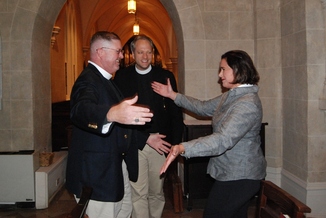
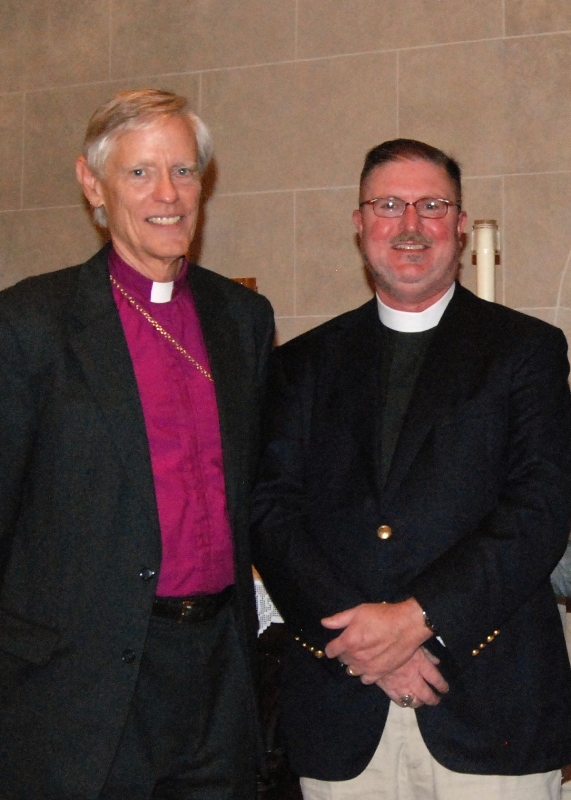
Bishop Charles G. vonRosenberg has welcomed a returning member of the clergy back into good standing as a priest, hailing the reinstatement of the Reverend H. Dagnall Free, Jr. as an important day for The Episcopal Church and an encouraging step toward reconciliation in South Carolina.

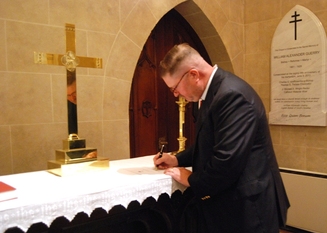
On Tuesday, in a brief liturgy led by Bishop vonRosenberg, Fr. Free reaffirmed the vows he took at his ordination in 2010 and signed a formal declaration promising to conform to the doctrine, discipline and worship of The Episcopal Church.

Fr. Free was a priest serving at St. John’s Episcopal Church on John’s Island in 2012, when a breakaway group under Bishop Mark Lawrence announced it was leaving The Episcopal Church. After the schism, a number of clergy remained with The Episcopal Church. However, Fr. Free stayed at St. John’s, which followed the breakaway group under Mark Lawrence.

Yet in the eyes of The Episcopal Church, he remained under Bishop vonRosenberg’s authority. Over a five-month period in 2013, the Bishop made efforts to contact each breakaway clergy member. In most cases there was no reply. In August 2013, with the advice and consent of the Standing Committee, the Bishop formally removed Dagnall Free and more than 100 other priests and deacons from the ordained ministry.

  read the rest here.........Episcopal Priest from Breakaway Parish Reinstated

Friday, February 28, 2014

I Just Had a Nauseating Experience

"In this latest debacle Salmon has revealed himself to be a prevaricator, a fence sitter and useful idiot for the episcopal administration". If you have the stomach for it, read David Virtue's excoriation of our former bishop, Edward L. Salmon, for inviting, at the request of 3 of his seminary students at Nashotah House, the Presiding Bishop of the very Institution that the seminary serves. Find it here--http://www.virtueonline.org/portal/modules/news/article.php?storyid=18628#.UxDaqeNdUdB I hesitated to expose the gentle, innocent public to this. St. Paul reminds us in his letter to the Philippians: "Finally, brothers and sisters, whatever is true, whatever is noble, whatever is right, whatever is pure, whatever is lovely, whatever is admirable--if anything is excellent or praiseworthy--think about such things." But as the demon played by Tim Curry in the movie "Legend" said, "How can there be light without darkness?" And so, I ask you to cast your eye for this moment upon some insidious darkness, that the True Light that has come into the world may be the more clearly observed. Warning! Prepare to be nauseated. If you can make it that far, read the comments to Virtue's commentary. Set the "sort" to "most recent". Our fine, Christian servant and former bishop of South Carolina who seeks to follow Jesus in conversation with all who are looking for him, needs our prayers. May his detractors not come under the same judgement that they apply to him. And let's remember what it means to be "catholic";,i.e., "all-embracing in the LOVE of God". CH+

Thursday, November 7, 2013

More from the Pope: Shaking Things Up

A friend commented on a similar story that the Pope is unlikely to change any doctrine or dogma of the church, while only seeming to shake things up in asking these pastoral questions. Maybe so, maybe not. But he has to start somewhere, and asking these questions is the right place to start. To bring about any of said changes, he would be working in some cases against over one thousand years of dogma.
CH +

Pope Francis asks bishops: How can the Church help same-sex couples? [and other queries]

Pope Francis celebrates a mass in St Peter's Basilica at the Vatican (AFP)
By Agence France-Presse
Tuesday, November 5, 2013 11:45 EST

The Vatican on Tuesday launched an unprecedented worldwide consultation on the new realities of family life including gay marriage as part of Pope Francis’s efforts to reform the Catholic Church.
A questionnaire has been sent to bishops around the world asking them for detailed information about the “many new situations requiring the Church’s attention and pastoral care”.
“Concerns which were unheard of until a few years ago have arisen today as a result of different situations, from the widespread practice of cohabitation… to same-sex unions,” it said.
Referring to gay couples, one questions asks: “What pastoral attention can be given to people who have chosen to live in these types of union?”The 39 questions are unusual because of their non-judgemental, practical nature in what could be a signal of greater openness and increased pastoral care regardless of a believer’s background.
“In the case of unions of persons of the same sex who have adopted children, what can be done pastorally in light of transmitting the faith?”
On remarried divorcees, who under the current rules are not allowed to receive Holy Communion in a Catholic church, the questionnaire asks: “Do they feel marginalised or suffer from the impossibility of receiving the sacraments?”
On divorce and separated couples in general, it asks: “How do you deal with this situation in appropriate pastoral programmes?”
The initiative is part of preparations for a synod of bishops next year and another in 2015 that the Vatican said will formulate “working guidelines in the pastoral care of the person and the family”.

Tuesday, October 22, 2013

A Little Rant, If I May...

With permission of the one being quoted below...

This falls under the category of sad, unnecessary division and disappointment in South Carolina:

So the other day, a fine Christian woman from our (TEC) congregation recently became engaged to a fine, Christian fellow. Some friends of hers who belong to churches in the (Non-TEC) Diocese of South Carolina asked her (and so she passed along the question to the clergy here at St. George's), and I quote: "I was told that some of my friends [from congregations in the non-TEC diocese] would be uncomfortable at best, and not supposed to attend, at worst [a ceremony that occurs in a TEC church]."

                                                       Let that sink in for a moment.

My goodness, what are these people being told? I heard someone who used to be a colleague (I still consider us brothers, even if he doesn't) twice say that TEC people subscribe to a "different religion". I couldn't disagree more. But even at that, do you really want to go there? I hope these people don't have any Jewish friends because they might be "uncomfortable at best, and not supposed to attend, at worst", their friends' children's bar and and bat mitzvahs. In the famous words of the Sunday Night Football broadcast crew...."COME ON, MAN!" I am sure these people would not feel uncomfortable, but rather amazed and enthralled, at a Jewish ceremony. But is a TEC church so far afield that to attend would be participating in something that is even more different than Christianity is from Judaism? Is a TEC congregation so awash in evil that to step inside would render one "unclean"? Or has the vilification of all that is TEC now taken so deep a root in the non-TEC psyche that reconciliation or even conversation is not now possible?

I continue to be saddened and disappointed that there is this strong undercurrent of division in the Body. As a deeply devout Christian in TEC, I want to know who told her that, and who has been filling their heads with this tripe? God have mercy on us.

CH+

Friday, October 11, 2013

From the Archbishop of Canterbury on Graciousness in Deep Disagreement

Now abide these three: Faith, Hope and Love, but the greatest of these is Love. I Co. 13:13
Or else the world will not listen...CH+
Are we missing something, indeed? Lifted from the Facebook page of the archbishop...

Christians in deep disagreement should choose ‘to be gracious’. - 

I want to say four things about graciousness and respect in disagreement. The first one is that disagreement is a reality; and when we deny that, ignore it, avoid it, pretend it’s not true, everything goes badly wrong. We all know that in a household or a community or a marriage if someone is looking sulky or saying very little, and you know there’s something wrong and they won’t tell you, it doesn’t help. When we look at the New Testament we see division and disagreement at every possible opportunity. Look at the beginning of both of Paul’s letters to the Corinthians, the first chapter of each of them. In 1 Corinthians he talks about a church entirely divided by people following one person or another; and in 2 Corinthians he talks about being in despair because things were so bad. In Philippians, he calls for reconciliation between two members of the Church – and remember this was in the days when there was no good communication, and yet from a great distance he’d heard the row, and he knew there was something wrong and he had to deal with it. In the Gospels, we see the apostles and the disciples arguing about who is the most important, right up to almost immediately before the crucifixion. They waste all their energy on disagreements.

The Church has historically always found it easy to divide, and we still do. And the issues which cause division are sometimes represented as principled issues, issues of theology – which is true; or they may be issues around discrimination against one group of the Church or another. I often think about the fact that in the 1960s when Afro-Caribbean people first came to this country they were not made welcome in our churches. It’s the reality; it was a sin, a very bad sin.

Division is a reality. Most of our divisions come down to issues of power and prestige. We dress them up in smart clothes around dogma and disagreement over doctrine; but at the very heart of them is very often a failure to be able to talk to each other, to communicate with humility that enables us to hear what the other one is saying.

I’m an Archbishop; I know about the absence of humility. I struggle with it. Sometimes it’s about money, but it all comes back to Jesus’s parable of taking the best seats at the feast. Power and prestige; they get under our skin.

We need first of all to recognise that we will disagree, we disagree, and therefore we need to be prepared and thoughtful about what is involved in disagreement. It is a reality.

Secondly, there is the question of reaction to disagreement.

We need to start by recognising we are family. The reaction must be from within the knowledge that, not by our choice but by the will of God, we belong to each other. To put it crudely and in an unsophisticated way, as the saying goes: ‘you can choose your friends, but you’re stuck with your family.’ And my brothers and sisters, I hate to tell you this but I’m family with you, and by the Lord’s grace, through the work of the cross, we are going to be in heaven forever. So we’d better start getting used to each other, because we’re stuck with each other permanently.

That’s the work of God. It’s not our option to say, ‘well we can go off and not be family.’ We are always family.

Thirdly, our response to division. And this is where grace comes in. Transparency is an element of grace, because of course God in his grace to us is transparent. He doesn’t say, ‘well, I don’t really mind about sin’. He says, ‘I hate sin but I’ve given a remedy’. We know where we stand with God; there’s no messing about. Having reacted, how do we respond? One thing I want to say, and I’ve learnt this in Africa as much as anywhere, is we need to act to be gracious. Sometimes you have to do things in order to become them. If we’re going to be gracious, act graciously. Whatever’s in your heart, act graciously – and the grace of God will often transform our hearts so as we act graciously we become gracious.

There’s a well-known story of Corrie ten Boom, the extraordinary Dutch evangelist and missionary. She was in her middle age, in her 50s, when the Second World War broke out. Her family sheltered Jewish refugees in Holland. They were betrayed by a collaborator, they were taken away to a concentration camp in Germany. Her whole family, apart from her, was killed; every single member. And after the war they were in Ravensbruck a really terrible camp, and after the war she was lecturing in Germany on forgiveness, and she gave her lecture and at the end she saw a man pushing his way to the front to come and talk to her. And she recognised him: he’d been one of the cruellest guards in Ravensbruck; he had tortured and beaten and assaulted and raped. He’d done terrible, terrible things. And he pushed towards her and – he didn’t recognise her – he said to her: ‘I was a guard in a concentration camp; I did terrible things. After the war, I found the Lord Jesus and he has forgiven me. I know you were in a concentration camp (she hadn’t said where), will you forgive me?’ And she said that in her heart was just hatred, but she stretched out her hand (I remember hearing her say this) and took it, and as she did so she felt the Holy Spirit dissolve the hatred in her heart and enable her to say with a full heart: ‘I forgive you’.

Now, forgiveness is not often that simple – let’s be clear, it may take decades, generations sometimes, we need to be honest about that. But we need to act in order to be. And when we disagree with each other there are moments when we need to act to be. We need to act to be. . . We need to pray so we can act. . . One of the top priorities for my time as Archbishop is a renewal of prayer and the religious life, the communities of prayer, without which there will be no renewal of the spiritual life in this land. . .

Finally, reconciliation. Reconciliation between us as human beings is not agreement – it is learning to love one another in deep disagreement. That is genuine reconciliation. It is being different. God is so wonderful, we are so different. The miracle of the church is not that we agree and love one another; it’s that we disagree and, despite that, we love one another. That’s the miracle that the Holy Spirit brings. So what happens when we’re reconciled, when we demonstrate diversity in love? When we demonstrate that, we’re straight into the last seven or eight verses of John 17. And the world will see that Jesus is the Son of God, and they will believe. . .

But reconciliation – I can tell you this after many years of working on it, both in myself and professionally in war zones around the world – comes with two s’s: service and sacrifice. If we’re going to have reconciliation, if we’re going to have graciousness and respect in disagreement, there has to be sacrifice. It is always costly to be reconciled. Within the catholic tradition I’ve learnt over the last ten years about the great sacrament of reconciliation: confession. It is enormously powerful and hideously painful when it’s done properly. . . It’s really horrible when you go to see your confessor – I doubt you wake up in the morning and think, this is going to be a bunch of laughs. It’s really uncomfortable. But through it God releases forgiveness and absolution and a sense of cleansing, a sense of knowing that we belong to him, that we’re his children. And if we’re to be reconciled to each other in CTE and across the church, and to see people come to faith and be disciples of Jesus Christ and to live out the transformation of our society to one of justice . . . we will see justice when we see a church that is alive in Christ and is calling with great power in the service of Christ. . . But that will take great sacrifice.

So, graciousness and respect in disagreement: the reality, the reaction, the response, the reconciliation. That we may maintain the unity of the Spirit in the bond of peace.

Thank you.

Justin

Monday, September 16, 2013

Ten Tips on Addressing Conflict Within the Church

Ten tips on addressing conflict within the church


I once was the rector of a parish that was made up of several different congregations that had declined or closed over the years. The rector who presided over one of the main assimilations, whose tenure was 12 years, and who immediately preceeded my predecessor, and then me by 5 years, had a deadly policy: "There will be no conflict here." He achieved this by mandating, for example, that there would be no solos in the choir (purportedly to quell competition and hard feelings). In similar fashion, he decreed that the baptismal font from the incoming congregation would be retained and used whenever a family member from that congregation was baptized (to avoid their sense of loss). I found out about this particular tradition by accident and out of ignorance, with much consternation. The same was done with the funeral palls. Another expression of this "no conflict" policy was that this rector also saw that a proportionate number of lay minstry was spread out among the component congregations as a percentage distribution, regardless of whether the calling, talent or excellence was present from each to warrant it. A sense of "what's fair" reigned over and prevented healthy grieving; excellence in ministry through recognizing and raising up gifts and talents gave way to a vanilla veneer of mediocrity. My immediate predecessor, who experienced 5 miserable years of conflict management and I, also of 5 succeding, challenging years, reaped the disastrous results of that "no conflict" policy. This unhappy situation also "ate up" my successor, until finally the congregation was temporarily moved to mission status, placed under a larger, healthier congregation, re-established and re-named. It is now a much healthier place with a bright future and a vibrant ministry, with many from those conflicted component congregations still present. It wasn't the people...it was that their inevitable conflict was delayed and allowed to strengthen underground until it became unmanageable. 

Please take heed to the following article. It could save you decades of intensive institutional therapy, not to mention personal heartache and stress. As the author says, conflict is inevitable. The key is how you deal with it.
Chris Huff +

From "Daily Episcopalian" on "Episcopal Cafe"


Ten tips on addressing conflict within the church

by Eric Bonetti
Conflict. Even the word itself makes us cringe a little. It has a hard, biting edge. In the back of our minds, the word conjures up unsettling images -- of dentists' drills, of that last really bad cold, of falling out of a tree as a child.
Fortunately, when we understand conflict, we learn to take a deep breath, to relax a little, to move past the immediate issues, and to view conflict as perhaps even a stepping stone to positive change. We may never come to enjoy conflict, but with perspective we learn to put it in its proper place.
So, next time you feel like you're about to be run over by a truck named conflict, here are ten tips to help you understand and work through conflict:
1. Conflict is inevitable -- Much as we'd like to pretend otherwise, conflict is as old as humanity. It happens among the closest friends, even among Jesus and the disciples. And like death and taxes, it comes to us all. So don't panic when you see conflict coming--it's just part of life.2. Churches may be particularly susceptible to conflict -- Avoiding conflict is easy when we get to pick and choose those around us. But in an environment that embraces diversity, there will, by definition, be a wider array of perspectives and viewpoints. As a result, there will be a greater likelihood of conflict.
3. Conflict doesn't make you bad -- Conflict, in and of itself, has no moral implications. Just because there's conflict afoot doesn't mean you're a bad person. Similarly, the presence of conflict doesn't reflect badly on your parish, your vestry, your priest, or your bishop.
4. Conflict can be healthy -- Growth requires change, and change engenders conflict. Handled appropriately, conflict can be a sign of positive change and growth. So next time you feel tension in the air, consider the possibility that something good is in the works.
5. Suppressing conflict is unhealthy -- Suppressing or ignoring conflict inevitably spells trouble. The underlying issue doesn't go away. Instead, like a locust, it goes underground, only to emerge later in spectacularly noisy fashion.
6. It's all about how we handle conflict -- Moral meaning attaches not to conflict itself, but to how we handle conflict. Remembering that we all are made in the image of God, assuming good intent, and avoiding "scorched earth" responses can go a long way towards de-escalating even the most difficult situation.
7. Choose engagement over fight or flight -- The old axiom about fight or flight as a response to threats misses the third option: Engagement. When conflict rears its ugly head, take a deep breath, relax, and "lean into" the issue. Promote engagement through use of "I" statements versus "you" statements, and by avoiding sweeping generalities. For example, "I feel like you are often late to meetings," is better then "You are late to every single meeting!" Test for understanding by reflecting back the other person's comments, "So you are saying it would be easier for you if the meeting were a half hour later?"
8. Get outside help when needed -- Sometimes, a neutral third party can be invaluable in breaking through layers of anger and misperception. If you're just not connecting with the other person, consider asking your priest, a professional mediator, or other trusted person for help.
9. Know that some situations require an immediate response -- Situations involving bullying or workplace violence, whether verbal or physical, require an immediate response to avoid potential damage to people or liability. Similarly, potential violations of fair employment laws, the canons, or issues involving sexual misconduct warrant a special response. When in doubt, act immediately to protect the vulnerable.
10. Persistent, high-level conflict is a warning sign -- Church, like work and home, should be something to which you look forward. If you find yourself dreading that next vestry or altar guild meeting, or you routinely dash out after services to avoid coffee hour, consider the possibility that a larger, more serious issue is afoot, and take steps to address it before it becomes even more toxic.

In short, while no one enjoys conflict, there's much that you can do to manage conflict, to reduce anxiety, and to move towards successful outcomes.

Eric Bonetti is a nonprofit professional in Northern Virginia with experience in change management and strategic planning. He is an active member of Grace Episcopal Church in Alexandria VA.
|  |  | Comments (2) 

Friday, August 30, 2013

Good Words from the Archbishop of Canterbury: "...to Love the Society in Which We Live, and to Bless it in Every Way That We Possibly Can."

Found at Three Rivers Episcopal

"The Church had a tendency to "come across too easily as negative", he said. "We deal in a secular world where it is assumed the Church has an agenda when we start offering our help to Government. We need to show that we do have an agenda: it's to love the society in which we live, and to bless it in every way that we possibly can. . ."  Archbishop of Canterbury Justin Welby
(exerpted from the article below)


Welby: Church needs to avoid drifting to divorce

Ed Thornton
by Ed Thornton for the Church Times, UK
Posted: 30 Aug 2013 @ 12:06
EVANGELICAL ALLIANCE
Click to enlarge
"Agenda": Archbishop Welby speaks at the EA launch
THE Archbishop of Canterbury said on Wednesday that the Church must not become like a marriage in which a couple have drifted apart and are content with their independent lives.
Speaking at the opening of the Evangelical Alliance's (EA) new headquarters in King's Cross, London, Archbishop Welby said: "It is too easy for the Church to be comfortable in separation, like a bad marriage where the couple has drifted apart, but not to the point where they'll divorce. They just sort of somehow live separate lives in the same house; they don't talk much except what's necessary to keep things running along. And they may not even notice that the separation is growing and deepening, but they live with it. And the Church can fall into that trap - in fact, over many years, has fallen into that trap."
Thanks to 3Rivers Episcopalian for bringing this to my attention.


Saturday, August 17, 2013

Out of the Gutter: But Why the Church Can't Just Go "Down the Middle" Either

This little analogy of a man trying to go bowling without understanding the point of the game is my attempt to illustrate the perennial mistake each generation of men and women in the church makes when they forget that God wants us chiefly to love (a la John 17 and St. Augustine). Instead, we split and divide in a default attempt to avoid the idea of uncleanness and impurity. We do this, not in a good way, like amoebas and other single-celled animals, but in a way that diminishes us and our witness each time we do it. We are not left as two complete wholes when we divide; we remain broken halves of a beautiful wholeness that God desires for us. It is what the early first century religious authorities in Jerusalem did while in the very presence of "Love" Himself. By our avoidance, we avoid the chance to love boldly. 

And mere compromise is not the way to remain one. In this analogy, a ball straight down the middle will not give you a strike. There needs to be a dynamic, energetic "spin" on the ball, and a throw to the right or the left of the lane until the "spin" carries the ball energetically through the middle at the first pin where there is great effect...and almost always a strike. This "spin", I believe, is love. This love enables us to cover more of the "lane", so to speak, which is the whole of our existence, with no one left out.

Please reconsider this slightly revised older post. It is a runup to a restart on this blog after a bit of vacation. And an attempt to address our problem in a positive way. When I saw a picture shared on Facebook by John Zahl, showing Muslims holding hands around a Coptic Church in order to protect Christians from radical violence while they held mass, I couldn't help wondering where that attitude is between us of competing factions in the church. As one commenter posted: "The Kingdom comes. And it seems people are always holding hands when it does." 

He Didn't Know Any Better

Once there was a man who came down from the mountain to the small town below. He wandered into a little  3-lane bowling alley and thought he might try his hand at bowling. "What do I do?" he asked the sleepy attendant. "Take these shoes, here's a pencil and a score sheet. And of course go find a ball you like." The mountain man put on the shoes, found a ball and sat at the bench. He did not know what to do with the ball, so he looked back at  the attendant who lazily motioned toward the lane. The mountain man noticed the grooves on either side, and noticed that they were the perfect size for the diameter of the ball. So he threw the ball right into the gutter. Down went the ball alongside the lane. Then it landed next to the pins at the other end and disappeared. The pin machine automatically lifted the pins and set them down again. He thought to himself he must have done something right, because they lifted up and down and a couple of lights flickered and flashed. He didn't have to wonder very long where his ball went, because, moments later, it appeared in the ball rack, all ready for another throw. "This is pretty easy," he thought to himself. And rolled the ball back down the gutter. He wondered about the point of the game, but it was such a perfect system, he felt pretty confident that he was doing it right. He paid for his game, gave back the shoes and left. The following week, the mountain man wandered down to the bowling alley again, and threw another 10 gutterballs, each time getting the ball back on the conveyor like clockwork for another throw. He got bored after awhile and left. "Sure is nice the way those heavy round balls glide so smooth down those grooves. But there's got to be more to this game." The mountain man never did learn the point of the game, because no one ever showed him what true bowling is.

The Gutterball of Division

There are four, or maybe nineteen jewish sects, depending on how you count it. In Jesus' time, there were different groups within Judaism, but they formed a whole: Pharisees, the rigid lawyers, Sadducees, who were less rigid with the law and more adaptable to the culture, the scribes, who were interpretive  teachers and copyists, the Essenes, who were ascetic and cloistered, the Zealots, who were militant, the priests, who were invloved in the temple and sacrifices, the elders, who were local council and synagogue leaders. The Herodians were loyal to the government of Herod. Other than some of the Zealots and Herodians, all these had different functions, and stressed different viewpoints, within Judaism, but were more or less part of a whole.  And whenever the Jews got off-track in the Bible, God always called them back. The call was rarely to "come apart", except to leave Babylon, or Egypt or some other idol-worshiping culture in which they experienced captivity. The call was never for Israel to split, although geo-politically she did into two kingdoms.

By contrast, there are reportedly roughly 41,000 Christian and non-Trinitarian Christian denominations and sects in the world. It is so finely divided that there are 11 different sects of  "Footwashing Baptists" alone. While many of these denominations do accept one another as members of the Body of Christ, many others don't, and require re-baptism, or some other accession to certain doctrinal points in order to be deemed righteous, and therefore "legitimate".

This, in the face of Jesus' most impassioned prayer to the Father that we be "one", is a sad, sad testament that our default position as Christians seems to be that of splintering, rather than being in union with one another. IT IS AS THOUGH, LIKE THE MOUNTAIN MAN, THROWING A "GUTTERBALL" IS ALL THE CHURCH KNOWS HOW TO DO. It seems at least since Corinth that we have forgotten how to play the game. As with the gutter, which fits the bowling ball so perfectly, it can seem that the most natural thing in the world is to start there with the gutter of schism.

When we in the church tire of one another's doctrinal errors, mistrust one another or experience stretching and growing experiences through some sort of change-agent, separating seems to be what we're best at, rather than reserving judgement, listening, praying together, entrusting ourselves to one another and working it out.  When doctrinal purity is the goal, splitting is inevitable, because everyone's doctrine changes over time. The only way to remain pure is to come apart.

But whenever groups gather around a common purpose (not a doctrine), but a purpose like providing clean water to African villages, or food and shelter for the homeless, or strength for the addicted, people of very different ideology can come together and experience love. This can't last long, though, because before long, we talk of our "beliefs", either political or religious, and we find reason to mistrust. And back we go into the gutter.

The Whole Point of Bowling

The whole point of bowling is to avoid the gutter, knock down the pins with the ball and make strikes. But you can't just go straight down the center and hit the middle pin dead center, either. That way you will plow through the middle bunch of pins and get a dreaded wide-angle split, with the pins at the extreme right and left still standing. The best players know how to use the whole lane. It is fascinating to watch them lay the ball down with a spin near the center of the lane. Then the ball "bends" out to the side near the gutter, only to bend back toward the center with some degree of force, hitting the middle pin in a way that sets it to spinning. It's like an explosion, and every pin is blasted down and away.

The church cannot seek merely to split the middle. Not enough of life is touched. But a dynamic, spinning church, energized by love, with enough flexibility to bend both left and right, covering all of life and not a narrowly-defined segment of it, can fulfill its true purpose, and bring glory to God in the eyes of a watching world.
Avoid the gutter, bend a bit and be energized with Love. That's how you play the game.

Chris Huff +


Tuesday, August 13, 2013

Taking a Cyber-Break

Hi, All. I'm taking a cyber-break for a few days, but will be back. Pray for a release of mind, body and spirit. Thta's what I pray for all who read this. Peace,
CH +

Thursday, July 25, 2013

Former New York Times Writer "Outs" Herself as a Creationist

Before you read this article, consider the following quote from Cynthia Bourgeault's new book, The Holy Trinity and the Law of Three: "In the name of intellectual respectability we [Christianity] have become habituated to a hiccup between scientific reality and biblical reality, with the scientific reality being the larger, more objective, "truer", and the religious being the smaller, more personal, and subjective. This is fundamentally crazy-making and is the root, I am convinced, of so much of the alienation and intellectual cynicism of the postmodern West."
--CH +
Nathan Schneider


Virginia Heffernan: A Creationist Against the Creationists

From the Huffington Post

Creationism

Former New York Times writer Virginia Heffernan stirred up the primordial soup earlier this month by outing herself, in an article at Yahoo! News, as a creationist. It was an effective provocation. Writers at places like Gawker, Slate, and io9 lined up to make their denunciations, predictably, and the conservative press generally came to her defense. Also predictably, things got ugly.
Heffernan is not exactly your typical head-in-the-sand creationist preacher. She articulates her position in a way that, I've found, is reflective of how a lot of people actually tend to see these things. She deftly manages not to dismiss, for instance, evolution or astrophysics altogether, but she doesn't find that they have as much relevance to her daily life as the Bible. To her, there is an opposition between the poetry of religion and the coldness of science, and given the choice she chooses the former.
"I never fell in love with science," she confesses -- and then concludes, quoting novelist Yann Martel: "A story with God is the better story."
But isn't a story with science and reason a better story, too? That, at least, is what huge swaths of the Christian tradition to which she belongs have concluded -- including the people who brought us creationism in the first place.
The distinctly modern phenomenon of strident, counter-scientific creationism is in large part the doing of a hydraulic engineer who taught at Virginia Tech named Henry Morris. Starting in the early 1960s, he began promulgating a method of "Creation Science" meant to show that the most pedantic reading of the Bible possible -- creation in six 24-hour days a few thousand years ago -- is actually solid science. Unfortunately, Morris's way of doing science required assaulting a lot of good science in the process, and his insistence on doing so very publicly won him and his followers a lot of attention.
Morris called his creationism "science" because he loved science, and he wanted to believe in it. This is about as far from Virginia Heffernan's brand of creationism as you can get. Other Christians, however, have proved much more successful in taking reason seriously in light of their faith.
God in Proof: The Story of a Search from the Ancients to the Internet by Nathan SchneiderConsider the 13th-century theologian Thomas Aquinas, for instance. A lot of us today -- at least among those who think of him at all -- tend to think of him as the fat man sitting atop a megalith of now-meaningless medieval jargon and law-like conclusions. Conservative-leaning Catholics sometimes mistake his dictates for an appendix to the Bible. But in his own time, while some of those same dictates were being condemned by that same church, he cut a very different figure.
The task that consumed Aquinas's life was that of making the dangerous natural philosophy of the ancient Greeks safe for medieval Christians. Borrowing heavily from the Muslims and Jews who had gone through much the same process over the previous few centuries, he sifted through the teachings of Aristotle and compared them to the best ideas Christians had already come up with.