Showing posts with label Christ and Culture. Show all posts

Tuesday, May 22, 2018

The Whole World Has Gone After Him


The Whole World Has Gone After Him

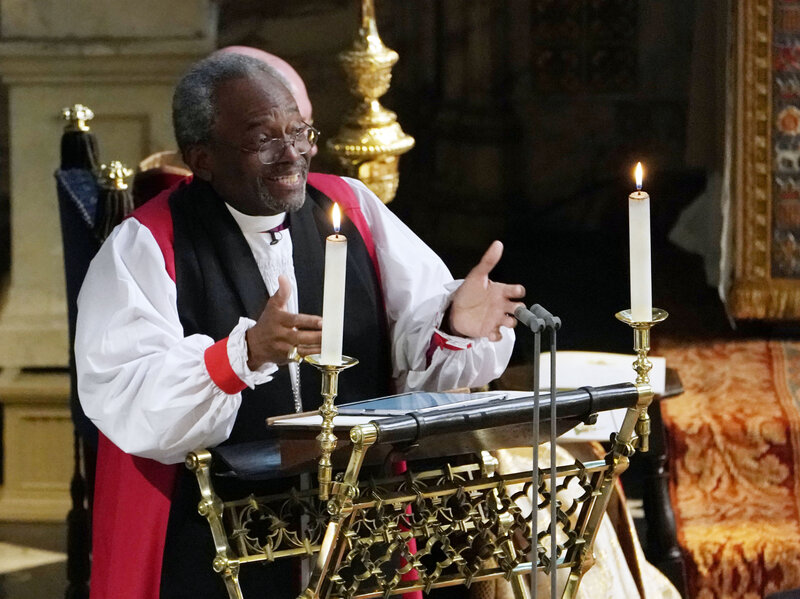
In response to Presiding Bishop Curry's sermon delivered at the Royal Wedding, some of the schismatics who are opposed to the Episcopal Church in general took a posture reminiscent of the Pharisees during Jesus' Triumphal Entry into Jerusalem: "They said to one another, 'This is getting us nowhere. See, the whole world is going after him,'" as though the fact that the world was so blessed and uplifted by the Episcopal Primate's hope-filled, winsome homily was a sign that there must be something wrong with it. A cheap gospel, they surmised. One post comment by an ACNA bishop called it an example of "Christianity Light" in contrast to their brand, "Christianity Max", as he referred to it. And here in South Carolina, where the Presiding Bishop is most welcome and visits frequently, we are accustomed to hearing from our former colleagues that "they (meaning we of the Episcopal Church South Carolina) ascribe to a 'different religion'". Isn't that what the threatened Pharisees are reported to have said of Jesus in John 12:29; that is, "the whole world has gone after Him."? 

For a sermon to have been so popular with such a wide range of people is not some automatic disqualifier, as the naysayers contend. The Royal Wedding sermon was authentically Christian. Its broad acceptance and glowingly positive reception by people of almost every stripe may simply be an indication  that the preacher wisely and lovingly took stock of the enormous opportunity that befell him. He preached the Good News  that God is for us and not against us on a global stage. He decided to eschew school-marmish, moralistic, pharisaical  religion in favor of the Good News that God hints to us through human love of a far deeper love still, one found in the sacrificial love of God in Jesus Christ. Contrary to the complaint of some naysayers, Bishop Curry went far beyond Cupid and Eros in the most gracious and pastoral way that the world has seen...well...quite possibly...ever in our lifetimes. He even suggested that with such godly love, we can change the world. (If THAT'S what the naysayers mean when they say that we ascribe to a different religion, then maybe they have a valid point.)

We who beam with joy at seeing the Archbishop of Canterbury and the Anglican Primate (Episcopal Presiding Bishop) of the United States standing together talking about an "unconventional Gospel- revolution of love" have been dismissed as those who have "itching ears", running after those who tell us only what we want to hear (II Timothy 4). My ears have indeed been itching. They have been itching for an encouraging word from a gifted preacher that everyone is created equal and is equally loved by the One who created us. Presiding Bishop Curry actually did what St. Paul enjoins us to do: "Preach the word; be prepared in season and out of season; correct, rebuke and encourage--with great patience and careful instruction." II Timothy 4:2 What we saw on Saturday in St. George's Chapel at Windsor was perhaps the most effectively evangelical use of 13 minutes the world has ever seen. Presiding Bishop Michael Bruce Curry did the work of an evangelist, par excellence.

Chris Huff
Priest in the Diocese of the Episcopal Church in South Carolina
Dean of the West Charleston Deanery

Be sure to check out my 10-part blog series entitled
"Why I Stayed (in the Episcopal Church)" 
See the side bar for easy access to it.

Friday, February 17, 2017

What's a Christian to Do? What's a Christian to Think? A Message to My Parishioners About Living in These Times.

Living in Today’s Political and Social Environment

How is a Christian to live today? Quietly under the radar, living peacefully and in prayer for all people? Participating in social activism by anything from marching with placards to boycotting businesses with questionable stances on human rights? Home-schooling our children in order to protect them from what seems to be a downward-spiraling society? Sending them to public school and helping to improve the school system? Voting for conservative government? Voting for liberal government? Wearing a safety pin to show your support for equal rights? Wearing a Trump tee shirt to show your support for immigration reform and trade protectionism?

The truth is that devout Christians represent all and more of the positions listed above.

How should  I, your rector, approach these matters? Since I am duty-bound to minister with equal care to all people in our congregation and community, I do not “preach politics”. This is not because I do not have opinions--believe me, I do!-- but because God loves us all equally. But most importantly, I have something better to preach than politics; and that is, as Paul says, “I am compelled to know nothing among you except Jesus Christ and Him crucified.” I Corinthians 2:2

That leaves us with an important assumption by which we must live: Whatever political/social/economic position we take as individuals, we will care for one another with the love of Jesus that we have received, and we will treat one another with dignity and respect. This leaves us free to follow Jesus in our unique and widely-differentiated callings.

Several varied and lasting lines of thought have arisen to which Christians have adhered down through the ages . Each has helped to shape political and societal behavior. All of these approaches have validity and legitimacy. All of these approaches need to be balanced by the others. We should study their  development in order to have healthy perspective and respect for each. This is a large part of what used to be the glory and heritage of us Episcopal Anglicans; i.e., that our roof, our baptismal vows and our God is great enough to house people of all stripes and stances and that, above all, we preach Christ crucified.

Richard Foster’s book Streams of Living Waters traces beautifully the 6 main streams, or traditions, of Christian expression. It is well worth the read lest, ignorant of our rich heritage, we neglect and forget some of the important aspects of who we are as children of God.

1) The Contemplative Tradition    2) The Holiness Tradition   3) The Charismatic Tradition
         The Prayer-Filled Life                   The Virtuous Life           The Spirit-Empowered Life


4) The Social Justice Tradition     5) The Evangelical Tradition    6) The Incarnational Tradition
       The Compassionate Life              The Word-Centered Life             The Sacramental Life

The beauty of our congregation at St. George's is that we have people who represent all of these faith traditions. This diversity of branches in our Christian Family Tree is what keeps us a healthy, cross-pollenated and--to use a loaded term, but by now you know what I mean--truly inclusive people.

Many traditions have been built upon the cornerstone of our faith. We need to include them all. I hope that our brothers and sisters across the wider communion will remember this, as well. And that includes those who speak through social media, as well!

Fr. Chris

Monday, November 16, 2015

It's OK to Grieve for Paris

To Those Who Would Criticize Those Who Grieve for France

Yes, it is true that so far in 2015 there have been approximately 297 documented terror attacks around the world: In January-30,  in February-12, in March-22, April-20, May-27, June-30, July-40, August 32, September-16, October-48, and so far in November-20. In some of these attacks, only the perpetrator was killed or injured. Fatalities or injuries in other attacks ranged from one to over 2,000. Methods used were shellings, bombings (IED's as well as carbombs), suicide bombings, beheadings, stabbings,  arson,  shootings, poisonings, vehicular attacks and more.  Beirut, the West Bank, the Philippines, Copenhagen, the Ukraine, Chad, Nigeria, Cameroon, Egypt, Afghanistan, Pakistan, Turkey, Iraq, China, Saudi Arabia, Yemen and other countries and regions have been affected. Some by militant crazies, others by rogue governments, lone wolves and many by radical jihadist groups and individuals. People who more visibly grieve over the IS attacks in France have been criticized by some for singling out France while purportedly ignoring other victims of terror attacks. Let me offer some reasons why the attacks in France may resonate more with those of us in the Western World:
1) France was a champion of "Liberte'" with us when we were struggling for independence as a nation.
2) France, like the USA, strives to live openly (which involves risk).
3) Paris, for goodness' sake, is universally known as "the City of Love" 
4) France and other Western European countries, like the USA, emulate principles of equality, freedom of speech and, for the most part, elective forms of government.
5) IS, by attacking innocent ones in Paris, brings a realization that it seems NOT to be so well contained, and is edging closer to us.
So when Paris comes under terrorist attack, many of us feel it more intensely and identify with it more. Many of us have been to Paris, and so grieve for it with more poignancy.
Take care to allow people to relate and identify. It can be part of their awakening,  and can serve as a reminder of what has happened to us on our own soil as well, lest we lose our vigilance.
Then indeed, let us also understand that the many other innocent victims in the many other countries are also just as precious in God's sight.
The best thing we can do is pray, and pray for our leaders, and pray for the free world (along with those who strive to be free) to band together in order to stamp out these threats and to live better than they do by enjoying our freedoms and thriving and prospering and living and loving to the fullest. And we must come to the aid of all victims and their families with our treasure and opportunity.
CH+

Monday, June 29, 2015

Good Article on Being a Pastor [Christian] in a 5-4 World

[In my church] the bottom line is this: all are welcomed in my church and loved unconditionally by God. And all are asked and enabled to become more than what they are when they walked in the door – a person who is continually growing and transforming into the likeness of Christ. --Travis Garner in "Being a Pastor in 5-4 World" (See link to article below)

We have been through so much change of late. Being an Episcopal priest born and raised and currently living in Charleston, South Carolina, a major flashpoint of the Civil War (politico-militarily in 1861, sociologically in the hospital workers' strike in 1969, and  ecclesiologically with the Episcopal Church schism in 2012), I have witnessed first-hand the difficulty with which change and progress is made. Now we have been stricken with community-wide grief over the racially-motivated Mother Emanuel murders, people have been divided over the confederate flag in part as a result, the Supreme Court made a ground-shaking decision by the narrowest of margins on the definition of marriage. Such a narrow decision bespeaks deep division in our society. I have experienced fear and anger from some of my friends over it. Finally, on a happier note, a man was elected, for the first time in history, as the first African American Presiding Bishop of the Episcopal Church. A glimmer of hope that an institution can be so united over what was once a deep division of ideology among us, especially those of us in the south. But so much change at once. Some of it we happily fell into. In some of it we were pushed over the top by a clearer perspective brought on by tragedy. With some of the change, however, we remain in transition...and division.

And the reactions to all this change are still evolving. Last Saturday one of my daughters posted on Facebook, "My Facebook feed this week looks like a battle broke out between the Confederates and a Skittles factory." I appreciated the humor of that, and the disconnect it brought me from the vitriolic tenor and tension that seemed to come to a head late last week. Facebook had become a wasteland of frustration and raw emotion. I hope Facebook in this instance has proved an effective lance for this boil and that we can actually go back to being "friends" soon.

In times such as this, one thing is clear: We need Jesus. Those who feel as though the moral fabric of our society has been irreparably torn need Jesus. Those who are elated over the changes established by the Supreme Court need Jesus. Those who feel that a little bit will have died inside when the confederate flag comes down from display on the State House grounds need Jesus. Those who would climb the pole and impatiently tear it down themselves need Jesus.  All of us do. I came across this article this morning, and offer it for your contemplation. As a pastor ministering in a 5-4 world, we need Jesus--together. Not "my Jesus" or "your Jesus", but the One who loves us all. We believers, after all, have been given the ministry of reconciliation. The vision of God in Christ is that we be one in Him. I suppose the issues, or our opinions regarding them, should not, then, be our guiding force. Instead, can we love and minister to one another, despite them...and better yet, through them? I can guarantee only two things, and they are 1) that these issues and their attendant changes will not be our last and 2) Jesus shall reign where e'er the sun doth his successive journeys run. Let's count on the latter to guide us through the former.

Chris Huff +

Article here:Being a Pastor in a 5-4 World

Sunday, April 12, 2015

Dealing With Tragedy in the Community, Resurrection Style


The following article first appeared in the Family Faith Formation Newsletter of St. George's Episcopal Church in Summerville, S.C.

Dealing With the Walter Scott/ Michael Slager Tragedy

The Gospel for this Sunday, the 2nd Sunday of Easter, is John 20:19-31. It includes the story of doubting Thomas, who would not believe that his fellow disciples had seen the risen Lord until he could see and touch Jesus' wounds. The only reality to which he could relate was the horror and brutality of Jesus' unfair and undignified death. He was traumatized beyond belief.

Our community has also witnessed an unfair and undignified death. And there are many things that we begin to doubt under the crushing weight of such sadness. Among them are: 1) We will never see justice and peace and security for all people. Evil always seems to prevail. But we are learning. So far people are binding together in community-wide understanding, and are opting for peace and openness, peaceful justice and change, rather than revolt and protest. 2) Police will never be honest and trustworthy. By far the overwhelming majority of police understand and practice sacrifice, courage and human kindness on a daily basis. Their families undergo the daily stress of the danger under which these officers work. They need our continued love, support and understanding. 3) This was the biggest, most avoidable local human tragedy in recent times. It is utterly senseless, and of no redeeming value whatsoever. I'm certain this is what the disciples thought as they watched their precious friend and Lord dying upon the cross. "The biggest mistake in history!" Thomas was so dejected in his grief and trauma that he could not imagine Life rising out of his situation. And while Walter Scott does not compare with Jesus, neither does Michael Slager represent the Evil One. A big, terrible mistake, misstep, unnecessary loss of two lives, essentially. But we can take comfort in something. Neither the closed door of the Upper Room, nor the stubborn refusal of Thomas to believe could keep Jesus out. And nothing could prevent God from accomplishing His purposes through Jesus, His Son.

If you find it appropriate to do, or if your kids ask you about it, talk with them openly, and let them ask questions. And all the while remember that no closed door (to our hearts or otherwise) and no doubts and questions can ever keep Jesus out of our lives. This is an appropriate time for you to model for your kids how to wrestle faithfully with the tough questions and challenges that life brings. They can learn so much from this, along with the rest of us.

Fr. Chris

The following prayer was offered at our services today:

Heavenly Father, whose will it is that all people should live together in peace, love and harmony, and in the new life of the resurrection procured for us by your Son Jesus Christ, look with pity upon our community, especially North Charleston,  grieved by the loss of Walter Scott’s life, as well as by that which caused the loss of Michael Slager’s freedom. Console their families with your presence. Strengthen us as we are challenged by our renewed awareness of the need for justice for all people. Comfort those in law enforcement, and grant them courage and compassion as they carry out their service. Give patience and wisdom to those who continue to experience injustice and oppression. Protect the weak, correct the sinful, rid us of our suspicions and heal our divisions. All for the sake of your Son, Jesus Christ our Lord. Amen.

Friday, February 6, 2015

What's Their Spiritual Temperature? A Note to Moms and Dads (Grandparents, Too!)

A Long Introduction (excerpted article appears below)...


Here at St. George's Episcopal Church in Summerville, South Carolina, we have a passion for coming alongside families and helping them on their spiritual journeys together*. In my late 50's, I find that I now have more time to walk the Ancient Paths of the church, linger in a prayer, practice lectio, meditate, contemplate the Holiness of Beauty (word reversal intended) and do the daily office. But my heart has been burdened for busy families with young children for some years now. How are they to find the time to walk these paths when parental responsibility constantly calls them away from them? They can make a rule of life, for sure. But time for God within that rule is more scarce than hens' teeth. Sickness, chores, errands, discipline, nightmares, carpools, teachers conferences (both planned and unplanned) can exhaust and leave time for little else. Then...a veil was lifted, and a path for these families appeared, when...

A Lutheran Diaconal Minister named Jennifer Vasquez, who is studying for her D. Min. in Family Faith Formation, and who graced our doorstep along with her young family over a year ago, introduced us to Faith5, a practice developed by Dr. Rich Melheim (see www.faithink.com) to give families of all ages easy access to the ancient paths without using the words (self-examen, lectio, confession, meditation and anointing/blessing), and in a more simplified and time-friendly form, designed to be used at night before bedtime (when all kids and parents...and spouses, for that matter... should be doing a daily "check-in" anyway). The five steps are Sharing (highs and lows)--"self-examen", Reading a Bible verse or story (that relates to the highs and lows)--"lectio divina", Talking (about how the verse relates to their highs and lows)--"confession", Praying (about the highs and lows) and finally giving a Blessing (as the last words heard before slumber)--"anointing". Not only does this have immediate benefits for young families, it also establishes a spiritual path that even teenagers will find helpful in more difficult times.

Below is an article that appeared in our St. George's Weekly Family Faith Formation Newsletter today (to subscribe, write me at chris.huff@att.net) . It is based on the Gospel for this Sunday (Mark 1:29-39), where Jesus heals Simon's mother-in-law of a fever. It gives parents and grandparents a way to touch the souls of children, take their spiritual temperature and provide spiritual "medicine", just as we would for their physical bodies.

CH+

What's Their Spiritual Temperature?

Moms and Dads (Grandparents, too), do you sometimes wish you held stock in pediatric thermometers? It's that time of year, and so many of us have helped our children through high fevers, coughs, sniffles and worse. When we look in on our children, the first thing we do is touch those little foreheads and those little faces with concern, ready to apply a cool cloth and good medicine to bring the fever down if necessary.

In the Gospel lesson for this Sunday (Mark 1:29-39), Simon Peter's mother-in-law was sick in bed with a fever. The story tells us that Jesus went to her...and the first thing He did was to touch her ("He took her by the hand and lifted her up. And immediately the fever left her.") I wish I could have seen the look of concern on Jesus' face when He first felt that fevered hand. Just like a mom or a dad, He gave her His healing touch.

When we check on our kids, we want to touch their souls, too, to see how they are. Don't you wish sometimes that you had a thermometer for their souls? Well, you DO! Sometimes we call it "sharing our highs and lows" (step 1 in Faith5 devotions). Checking in on our spiritual temperature, then, is another way to look at it.

And don't you wish there was a good medicine to bring that spiritual fever down? Well, you HAVE it! It is God's Divine Touch administered through your loving hands. Don't forget to bless and TOUCH your children lovingly every night before bedtime after checking their spiritual temperature. The Bible tells us to anoint each other with oil for healing (the oil reminding us of our baptism and represents the presence of the Holy Spirit). This Sunday every family will receive a small bottle of olive oil for anointing (blessing) at night. Trace the sign of the cross on the foreheads with oil (just as at their baptism). Something tells me your little ones will come to treasure this in their lives. Around here, we have discovered that they love blessing us back!

Blessings and Peace,
Fr. Chris

From St. George's Weekly Family Faith Formation Newsletter 2-6-15 ed.

*Studies show that parents are the most effective and important spiritual mentors for their children.
Combine this fact with a statistic (By the time a child reaches grade school, he will  have spent more time with the television than he will with his father for the rest of his life), and one can see how life-changing something like Faith5 can be.

Tuesday, November 25, 2014

Muslims in the National Cathedral? What's Next? Dogs and Cats Living Together?

Under threat of cosmic cataclysm (the end of the world) in the comedy movie, "Ghost Busters", para-psychologist Dr. Peter Venkman, played by Bill Murray, at an emergency "high summit" meeting in the office of the mayor of New York, offered a "non-technical" translation for the local dignitaries assembled: "That's right. Human sacrifice, dogs and cats living together, mass hysteria!"


It had been a while since I had gotten into a rip-snortin' exchange of opinion on Face Book. I had learned (or so I thought) to leave others to theirs and simply pass along the occasional joke or catch up with a friend or family member. But then someone posted a piece by Franklin Graham decrying the National Cathedral's hosting of a Muslim prayer service. Other friends piled on. A "shame" and a "disgrace", they called it. A "desecration". Muslims were being compared to Baal worshipers and witches. "Mass hysteria!" And I began to wonder if there is any hope if some of us who claim to be followers of Jesus could be so non-conciliatory and indiscriminant with their hatred. But I remember that ignorance is the basis of much fear. And knee-jerk reactionism is far easier than taking the trouble to be measured and thoughtful--indeed, loving (especially if loving is to include our perceived enemies).

But I don't think these people intend actually to hate; they are some of the best and kindest people I know. They don't know what to make of a radical fringe of Islam that has declared a jihad against Western Civilization. Not having studied or experienced devout Muslims personally, they lump them all together as a group to be feared physically and spiritually (isn't that what they call prejudice?). They paint them all as wild-eyed murderers. So it is no wonder that when they hear of Muslims being invited into the National Cathedral of the Episcopal Church for a Muslim prayer service, they seriously ask (in ignorance) "Why is our National Cathedral inviting people who fly planes into our buildings in the name of Allah to offer prayers in the name of Allah? This is a desecration!" How fearful it must be for the average Muslim to be so easily lumped in with terrorists. How disingenuous it is for Christians to do this.

And about Franklin Graham. It was his blog article from which they drank this bowl of indignation, ignorance and fear. It's time for him to come out from behind his father's respected and honored robes and quit stoking the flames of mass hysteria and misunderstanding among the less educated on these matters with his cowardly potshots (the pulpit can be a coward's haven) at a denomination with which he has nothing to do (the Episcopal Church), nor any appreciation for. His rigid interpretation of scripture ("No one comes to the Father except through me"), as well as his virulent brand of xenophobia (Lord, WHY do these people always have such a big stage?) has maligned the reputation of a very large swath of humble, devout people. Indeed, these have put an innocent culture at risk. Would we Christians (seriously, think about this) deign to persecute an entire race, a heritage, a culture, a religion? Nationalism, combined with religious and racial exclusionism, can be a very dangerous brew. Read a little history, please. You don't have to go back even just a little bit.

Listen to the words of a Kenyan Christian who learned from his Anglican priest grandfather to appreciate and honor other religions:

"Today Kenyans face an enemy who is strategically creating distrust between Muslims and other religious communities, especially Christians, for his own purposes. This enemy has chosen to hide under the guise of Islam because they know that most Kenyans only understand the doctrine and ideologies of their own religion. They know that an average Hindu, Christian, Muslim, Buddhist, etc tends to be completely ignorant of the doctrines and ideology of other faiths and in fact; in that funny way of religion, will often look down on other faiths and categorize them as false [if not downright evil!]."
"This enemy understands the ethnic schisms of our nation, the historical fault-lines of the Kenyan state, and the historical narratives of injustices and marginalization in our communities. He is now using this social environment to propagate a war of terrorism that he then presents to us as a warped ideology of Islam; one meant to make even the most tolerant of us angry; very angry!
Unfortunately it is working. It is also turning us against genuine adherents of Islam; those people my late grandfather admired. This ignorance of other faiths and exclusivity of our own is being used against us."   --NGUNJIRI WAMBUGU, in an opinion piece entitled "Kenya: We Must Not Allow Religious Intolerance to Thrive." (Credit Jim Simons in his blog "Three Rivers Episcopal": the article can be found here: http://allafrica.com/stories/201411240090.html  )

There are unfortunate similarities here in the United States, where prejudice is too often the easier path taken. A journalist friend of mine, Ellen Dooley, aptly stated:

"The issues we--humans across the globe--face at this moment in history demand the deepest, most critical thought, the most rigorous scholarship, the cross-disciplinary collaboration of all people of good will--lives are at stake and the very earth shudders with grief. We do no honor to God by refusing to listen, refusing to learn, insisting that self-righteous indignation and plainspoken ignorance is superior to the thoughts and ideas and traditions of those who have devoted enormous energy and effort to the study of history, politics, theology etc.

 Can we stop wringing our hands over the silly notion of "protecting" or "defending God's honor," as though the Creator were a fragile, simpering Victorian prone to fainting spells? This is the Lion of Judah we're talking about."--Ellen Dooley
As for the actual event in question, several hundred devout Muslims were invited to offer prayer in what Bp. Mariann Budde calls "a house of prayer for all people".

South African Ambassador to the United States, Ebrahim Rasool preached the sermon. Rasool and chief liturgist of the Cathedral, the Rev. Can. Gina Gilland Campbell had collaborated together on Nelson Mandela's funeral, and as they continued on in association and friendship, conceived the idea of this service as a call for peace and tolerance among the religions.

Rasool preached in part:
"Extremism is not the antidote to extremism. Extremism labels because it cannot debate. Extremism excludes because it cannot embrace. Extremism is angry because it cannot love. Extremism destroys because it cannot build. Extremism has perfected the art of dying for its cause because it has forgotten how to live for its cause."
Ironically, the hospitality of the moment was marred by an extremist, a woman who rose and interrupted, shouting:
“America was founded on Christian principles. . . . Leave our church alone!” She was swiftly ushered out by security aides, and the service continued. She was not arrested. She briefly became the poster child for those who fear sharing prayer with people of other religions. 
Some may ask, "Isn't this poking a stick in the eye of a people (red-blooded Americans) who have been attacked by terrorists who claim to be Muslims?" Ask any of the many Muslims who serve in our armed forces that question. I wonder if their blood is as red as any other American's. In times like this, reason, calm and tolerance must be upheld, exampled and held out as a lamp for the nations. 
As for us Episcopalians (not all of whom agree) modeling Christian hospitality and tolerance: If not us, who? If not now, when?
What we don't need in this world is encouragement toward "mass hysteria" with un-marinated, uncooked, un-filtered, un-thought-out reaction to constantly-breaking, un-marinated, uncooked, unfiltered and un-thought-out news.
We do need lots of prayer, meditation, community, acceptance and wisdom based on thought, hospitality, love and study. 
CH+ 
For some fascinating and enlightening reading, see:

Worshiping Jesus in the Mosque

What it's like to follow Christ embedded in Muslim culture. An interview with a Muslim follower of Isa [Jesus]. at http://www.christianitytoday.com/ct/2013/january-february/insider-movement-islam-wheres-jesus.html


Friday, October 10, 2014

Sensible Words for Christians in America

Bp. Greg Brewer posted this and I am "stealing it" to show to my circle of friends. Pluralism is a reality that provides us with tremendous opportunity. We just have to see it for what it is, embrace it, and work within it.
CH+

5 Guidelines for Living in a Pluralist Society
Image: John Ashley / Flickr
Two months ago, I wrote an article for CT that explored the issues and complications surrounding the growing tensions between religious liberty and LGBT rights. I also suggested that Christians ought to pay greater attention to pluralism, an idea that I explore in more detail in this academic article (and in an upcoming book).
I am grateful to CT’s editors for the invitation to share some additional thoughts about these and related issues, and I plan to do so in a series of essays in the coming months. In this essay, I want to explore the contours of our society’s pluralism, and how Christians might engage with our pluralistic world regardless of where they find themselves in it.

Out of Many, One?

Our nation has many aspirations toward unity and a common good. Our Constitution sets a course for “a more perfect union.” Our politicians speak of a great “melting pot” that flows out of a “nation of immigrants.” Our pledge of allegiance refers to “one nation.” Our nation’s seal, E pluribus unum, promises “Out of many, one.”
These aspirations are to some extent realized. Almost all Americans agree about the background practicalities we need to live as a society. Most of us agree that we need public roads, national defense, fire departments, and the like. We also agree today on many basic features of a democratic society: the right to vote, the right to due process of law, the right to free speech. We disagree—sometimes sharply—about the contours of these rights, but we usually have enough of a baseline to recognize the nature of our disagreement. And importantly, we agree about many basic laws, like those protecting life and property, the payment of taxes, and the operation of courts and prisons.
 
Read the rest here: Winsome within pluralism

Wednesday, October 1, 2014

A Homily for the Am Ha'Aretz


I recently married my nephew and godchild, Michael Huff, to his beautiful bride on a barrier island off Charleston, South Carolina, called Folly Beach. It is a place of magic for many. Popularly dubbed the "Edge of America", it is a place where generations have returned to the womb, reconciled with Mother Earth, and found their way home to God. Michael and his bride, Leah (the name of my deceased sister) Eppehimer, share a unique love of mud and water (he is a crabber. oyster-man and sharker) and ocean (they both are free-spirited surfers).
Nature is our first home. The church, our second. We need to reconnect the two. They belong together.
The Am Ha'Aretz, or the "People of the Land", is a term found in the Tanakh. The Hebrews were an earthy people. So are we, although we have become disenchanted with earthiness. Lest we become too sterile of spirit, let us cross that bridge.
This wedding was performed under the threat of a coastal storm. God held back the rains and gave us one of the most beautiful sunsets seen in recent times.
CH+
A Homily for the Am Ha'Aretz (Michael's and Leah's Marriage Homily)
Michael and Leah remind me of Adam and Eve in that they met each other in the beauty of nature. Only….their relationship was conceived and fostered through an intimate connection with the primordial ooze of pluff mud and the primal, nurturing, mystical power of the ocean.

Their relationship has been baptized, you could say, in the waters of Folly Beach. And now a family whose own relationships have been fostered a bit north in the waters of the jersey shore have come to support in love and prayer the baby of her family, Leah, in her  marriage to the baby of his family, Michael. So here we all are, about to be baptized by water from the heavens themselves. What a joining, sealed by the Holy Spirit in baptism and family and matrimony and mud and sand and garden and love.

We in the church are familiar with the phenomenon described by the phrase, “Spiritual, but not religious”. Open to spiritual ideas, and hungry in heart for answers in life. Just not so enamored of churchy stuff.

I get it that for many “Mother Church” has come to seem “Old Fashioned”, perhaps even irrelevant, in the minds of some. And yet the faith into which you both were baptized has drawn us all here today, and through our prayers and love sustains you, as well as all of us. The transcendent God of the universe came, in the person of Jesus Christ to build a bridge between the ancient paths of the first magic of God’s creation to all of mankind and the future. We call it “Ancient-Future”, the gathering of all things past and present unto Himself.

Whether or not we realize it, we are all standing on that bridge that God built. From our baptism in the waters of the church… to where we stand today…not just physically here together, but situationally, wherever each one of us finds ourselves at this moment in time.

Do not burn that bridge. It has spanned human lifetimes and, although perhaps old and creaky here and there, it is large enough and plenty strong to hold us all on our journey through this life on earth to our eternal destinies, established in the heavens.

And now especially to you two, Michael and Leah. Anyone who has been married for longer than five minutes knows that storms will come. You will, and perhaps already have, hurt each other. As St. Paul says, “Put on compassion, kindness, humility, meekness and patience. Bear with one another and, just as the Lord has forgiven you, so you also must forgive. Above all, clothe yourselves with love, which binds everything together in perfect harmony.

In just a moment you will give your vows to one another. Not only are you giving vows; you are giving your souls to each other. And we who love you are witnesses. And we support you. May you ever deepen in the love that brought you here, and find the deep blessings of God in your lives, which now are becoming one in Jesus Christ. Amen.  
The Rev. Christopher M. Huff

Wednesday, July 16, 2014

Soon Came Later.

Back in April, almost a full 3 months ago now, I declared that I would soon be back on this blog. My how time flies!

Cranking the old blog back up after taking a hiatus has been much more difficult than anticipated. This is not because I haven't had had much to say. Instead, it is because the church that I serve has not slowed down one bit for the summer. To the contrary, St. George's in Summerville has done nothing but ramp up, heat up and speed up. That's a beautiful thing, because it means life is happening here. Although I have never been one for "taking my ease", I have not on purpose created this "busy-ness", either. People are responding to the Gospel of love, and are paying attention to their lives in Christ. They are growing deeper, and are inviting others into those depths where the pulse of God's heart beats strongly. Thanks to my colleague and partner --and boss (he hates when I call him that)-- the Rev. Rick Luoni for the honor and privilege of joining him in the work of God in this place.

Now the Episcopal Church in South Carolina is defending herself in a lawsuit brought against her by Mark Lawrence and the congregations that are aligned with him. I have written at length about my experiences in the run-up to, and the experience of, the schism in my blog series entitled "Why I Stayed". So now I intend to write about good things, positive things; indeed, healthy things a la Philippians 4: 8-9. 

Our diocese last week announced that clergy now have permission, under certain pastoral guidelines that were developed by Bp. Charles von Rosenberg and a committee working with him, to use the approved rite of the Episcopal Church, "The Witnessing and Blessing of a Lifelong Covenant". I served on that committee with some truly outstanding minds who are equally respectful and loving of heart. The conveners of the four deaneries of the diocese, along with representative laity from those deaneries, met regularly with the bishop and members of his staff. The bishop wanted to put this policy in place for the protection of all involved: same-gender couples who desire to have their life-long covenants blessed by the church, the congregations to which they belong, those who have opposing views, and finally their clergy. Our process included consulting with other dioceses around the country as to their processes, their conversations, their policies and their experiences. We dialogued, we did theology, we developed a curriculum, and a suggested method of conversation. We prayed together, we included provision for follow-up and evaluation, and we provided links and a bibliography to assist those who are interested in further study on their own. 

Resolution A049, which was passed by the General Convention of the Episcopal Church in the summer of 2012, stipulates that while permission to use this rite as a pastoral response to those who request it is granted, no bishop, priest, deacon or lay person may be coerced into using the rite, or be punished for conscientiously objecting to use it. I, for one, value and treasure the bonds of  fellowship that I have with those who will be using this rite in our diocese. I say this as a past Diocesan Examining Chaplain in Ethics and Moral Theology (for 19 years) and as a former adjunct professor in Systematic Theology and Ethics and Moral Theology for Trinity Episcopal School for Ministry. 

Our diocesan policy states that in order for this rite to be used in the church, among other guidelines, there needs to be a couple affiliated with a congregation who desires the rite, a willingness on the part of the rector to do so, and finally that there must be dialogue on the matter and approval by the vestry of that congregation to use the rite.

As it happens in our parish at St. George's, to my knowledge we do not currently have any gay couples in a committed relationship who wish to have their love blessed by the church  in a covenant of lifelong commitment. While this is true for us, there are other congregations in our diocese for whom this is a pastoral reality.  Due to the past environment in our geographical region, we, as with other parishes, have not been afforded open dialogue about this pastoral question. While the question, then, is moot for us St. George's now, we will have opportunities for dialogue sometime in the future.  True to the character of the Episcopal Church, everyone's position will be respected, and everyone will respect the dignity of every human being, as we promise in our baptismal vows.

Later I want to take up certain aspects of this topic and perhaps even wax theological. But for now I ask that we all remember that there are people behind this issue; people who deserve respect and dignity because we are children of God. People who are members of the Body of Christ, and who are valued members of our community. I am glad that people are finally being affirmed for who they are by the church. I am glad that Love trumps Law, and that at  the Cross the ground is absolutely, unequivocally, and  thoroughly level. Without exception.

CH +

Beautiful.. christian bible verses about love - Google Search


Friday, February 28, 2014

I Just Had a Nauseating Experience

"In this latest debacle Salmon has revealed himself to be a prevaricator, a fence sitter and useful idiot for the episcopal administration". If you have the stomach for it, read David Virtue's excoriation of our former bishop, Edward L. Salmon, for inviting, at the request of 3 of his seminary students at Nashotah House, the Presiding Bishop of the very Institution that the seminary serves. Find it here--http://www.virtueonline.org/portal/modules/news/article.php?storyid=18628#.UxDaqeNdUdB I hesitated to expose the gentle, innocent public to this. St. Paul reminds us in his letter to the Philippians: "Finally, brothers and sisters, whatever is true, whatever is noble, whatever is right, whatever is pure, whatever is lovely, whatever is admirable--if anything is excellent or praiseworthy--think about such things." But as the demon played by Tim Curry in the movie "Legend" said, "How can there be light without darkness?" And so, I ask you to cast your eye for this moment upon some insidious darkness, that the True Light that has come into the world may be the more clearly observed. Warning! Prepare to be nauseated. If you can make it that far, read the comments to Virtue's commentary. Set the "sort" to "most recent". Our fine, Christian servant and former bishop of South Carolina who seeks to follow Jesus in conversation with all who are looking for him, needs our prayers. May his detractors not come under the same judgement that they apply to him. And let's remember what it means to be "catholic";,i.e., "all-embracing in the LOVE of God". CH+

Tuesday, November 26, 2013

If We Were Only More Aware of Ourselves...


My "boss" (well, he prefers to call us partners in ministry), Rick Luoni, posted this brief reflection based on some reading that he is doing in Emotional Intimacy: A Comprehensive Guide for Connecting With the Power of Your Emotions by Robert Augustus Masters, PhD. 

I offer this as a seed for new personal awareness. Pretty good seed.
--CH+

Rick LuoniRick Luoni, Rector of St. George's Episcopal Church, Summerville, SC


I was reading my new book, Emotional Intimacy, early this morning. 

The chapter was COLLECTIVE FEAR.

COLLECTIVE FEAR is what he called “our” fear and “the” fear, infiltrating us with its energies and core message: “we are threatened, we are in danger, and we are at the mercy of far-from-benign forces.”
He says such fear is amplified by political/religious leaders. 

One can easily see how harmful and destructive COLLECTIVE FEAR can be to the soul of a nation, the soul of the Church, and the soul of a person. “We must fear those who are different!” “We must be cautious of those who do not believe like us!” It was COLLECTIVE FEAR that screamed "Crucify him!"

Masters writes, "When we are in our COLLECTIVE FEAR we may find ourselves sidestepping it, rising above it, withdrawing, and disassociating from it as much as we can."

He adds:
we avoid through numbing
we fight with aggression-- words and actions.
we flee by disassociating
we transmute the energy of fear into the energy of unhealthy anger.
we “righteously target” the shortcomings of those “we” fear.
And then we become (and I found this extremely interesting) "we become obsessed with sexuality"…. What??????
In laboratory studies, the more afraid an overcrowded collection of rats is the more hyper-sexual they become.

Hmmm. That’s strange. Rats obsessed with sex? Apparently some fear-based people become obsessed with sex, according to this doctor.

I wonder how many wars and divisions among people could have been avoided if leaders had done their inner work? Faced their fear rather than avoiding, fighting, fleeing and projecting it on to others? What if they had the courage and faith to explore beneath the surface of the souls, to examine and sit with their fear? “When you are disconnected from your deepest Being, you’re in sin.” (r.rohr) “You or your group cannot be spiritually mature while remaining emotionally immature (disconnected from one’s deeper self and emotions.) (P. Scazzero)

1 John “Perfect love (what we practice; action) casts out fear (what we believe or think). There is no fear in love.”

We don’t THINK ourselves into a new way of living; but we LIVE ourselves into a new way of thinking.

Sadly many or most "leaders" can't or won't hear this... they are too fearful.

I need to be with this for a while.

--Rick

Thursday, November 7, 2013

More from the Pope: Shaking Things Up

A friend commented on a similar story that the Pope is unlikely to change any doctrine or dogma of the church, while only seeming to shake things up in asking these pastoral questions. Maybe so, maybe not. But he has to start somewhere, and asking these questions is the right place to start. To bring about any of said changes, he would be working in some cases against over one thousand years of dogma.
CH +

Pope Francis asks bishops: How can the Church help same-sex couples? [and other queries]

Pope Francis celebrates a mass in St Peter's Basilica at the Vatican (AFP)
By Agence France-Presse
Tuesday, November 5, 2013 11:45 EST

The Vatican on Tuesday launched an unprecedented worldwide consultation on the new realities of family life including gay marriage as part of Pope Francis’s efforts to reform the Catholic Church.
A questionnaire has been sent to bishops around the world asking them for detailed information about the “many new situations requiring the Church’s attention and pastoral care”.
“Concerns which were unheard of until a few years ago have arisen today as a result of different situations, from the widespread practice of cohabitation… to same-sex unions,” it said.
Referring to gay couples, one questions asks: “What pastoral attention can be given to people who have chosen to live in these types of union?”The 39 questions are unusual because of their non-judgemental, practical nature in what could be a signal of greater openness and increased pastoral care regardless of a believer’s background.
“In the case of unions of persons of the same sex who have adopted children, what can be done pastorally in light of transmitting the faith?”
On remarried divorcees, who under the current rules are not allowed to receive Holy Communion in a Catholic church, the questionnaire asks: “Do they feel marginalised or suffer from the impossibility of receiving the sacraments?”
On divorce and separated couples in general, it asks: “How do you deal with this situation in appropriate pastoral programmes?”
The initiative is part of preparations for a synod of bishops next year and another in 2015 that the Vatican said will formulate “working guidelines in the pastoral care of the person and the family”.

Monday, September 23, 2013

Sense or Sensibility: Why Careful Interpretation is Indispensible

This has been a tough one to hone down to "Blog-Size", so I have decided to turn it into a series. There is so much to be dealt with in the church concerning BIBLICAL INTERPRETATION. It is the hinge upon which all things, i.e., our (the church's) authority to say anything to the world, turn. And yet I have seen some BAD, if not well-meaning, biblical interpretation from most sectors of the church. Throughout history different means of interpreting the Bible have arisen out of successive cultural mileus and philosophical substrata (see my post entitled "Enculturated Gospel: Get Used To It". Also see my page on this blog: "Culture Wars"). Most have given birth to lasting traditions, some of which still speak to us today. We have the soul-feeding , yet highly subjective allegorical and typological interpretations of Scripture from the Early Fathers. The Great Reformers  put the Old Testament in line as a one-two punch of the continuing revelation of God from announcing and presuming and prophesying a coming Christ to a realized, crystallized Jesus the Christ of the New Testament. The early "liberal" theologians gave us text-criticism in an attempt to give us the tools to find the plain meaning of the texts. We have the monastic tradition of Lectio Divina and Ignatian Prayer of Imagination  with scripture where one engages in interaction with a biblical scene as though  he or she were a participatory character.

In several sermons, I have used the analogy of those wonderful acetate transparencies one finds in anatomy books. The first page, super-imposed upon the successive ones, shows the flesh. The next page reveals, in situ beneath the flesh, sinew and bone. Beneath that, organs, and so on. As we approach a passage, the first layer may be to take the words as if you found them lying open on a coffee table. What do the words say, out of context, in plain English? The next layer might be to investigate the audience, the type of literature we have (genre), the original languages, the culture out of which these words arose, etc. A next layer might be to ask God what these words now say to us in the world in which we are rooted. You get the idea.

I am reminded of what one of my former Old Testament professors said: "At the end of the day, after all the interpretative work that you can bring to bear upon the scriptures, I don't want to get anymore out of the Bible than my grandmother did." I know what he meant. And I appreciate that he was trying to relieve of us the angst brought on by the sterility of the critical  "lab". After all the genre analysis, cultural studies, text-criticism, philological application, etc., he wanted us not to lose the ability to sit faithfully before the scriptures and to allow God to speak to us afresh--in the moment, via the Holy Spirit. I get it. And thankfully He does speak to us through those pages.

Unfortunately, in this day and age, we need to know more than our grandmothers did. There are those of us who hold the scriptures near and dear  as authoritative and formative, as well as the source of healing and hope for our very lives. The globe has pressed in upon grandma. We know more than she did. We have many, many more voices speaking on our desktops and in our phones. As culture changes rapidly, we are tempted to haul out those very Words as weapons of defense, rather than as words of life, Good News, peace and unity. Indeed, the Word of God (and the author to the Hebrews was talking about the Old Testament here!) is sharper than a two-edged sword, dividing between soul and spirit, joint and marrow. I am reminded of Hecuba of Troy: "He who has great power must use it wisely." And so we must take great care not to slice unnecessarily someone's soul over a matter of biblical interpretation that we have not taken great, and I mean GREAT, care to understand in its true embedded meaning, as well as its freshness for today. A great sword in the hands of a child (and there are many theological "children" out there) can do indiscriminate and permanent damage.

Among our greatest needs in the church today, as in every generation, is to understand the relationship to us of well over half of what we call our Bible (the Old Testament), what it has to say, if anything, to the New Testament, and vice versa, and to our world.

John Bright (dec), Professor of Hebrew and Interpretation of the Old Testament at Union Theological Seminary, wrote in his book, The Authority of the Old Testament: "The Old Testament is different [from the New] in that it was not in the first instance a document of the church at all: it was not written by Christians for Christians. The more seriously we take it in its plain meaning, the more clearly we see that it is the document of a religion (genetically) related to our own, yet not precesely the same as our own. It is a document of the faith of old Israel, and only secondarily a document of the church. Its message is not of and by itself a Christian message. [!] ( Emphasis mine) Yet we must preach a Christian message from it...if we are to use it in the pulpit at all." (p.182 1975 Baker edition) This seems obvious to me, but p;ease understand something; this makes many Christians uncomfortable. "What do you mean, 'Its message is not of and by itself a Christian message?'" And yet, most Christians I know, even the most faithful among us, do not follow most of  Hebrew Law. Children often expose the truth: "Mommy, why did God kill that guy that tried to keep the ark from falling off the cart? He was just trying to help!" (2 Samuel 6:6-11) This story of retribution for disobedience of the rules concerning who could and who couldn't touch the ark is certainly not, at least on the surface, a message of grace and mercy. "The anger of God broke out upon Uzzah."

Bright goes on to explain that to confront our congregations with the demands and promises of Israel's faith is to impose upon them a perspective that is not, and cannot be, our own. We have to see it as a document that looks for a Christ, but doesn't announce Him. "How is this B.C. text to be preached as a word to the church without distorting its meaning?" he asks.

I'm afraid that this question is not explored with as much diligence as it should be these days. Our failure to grapple with this question with honest intellect, as well as mature spirituality, has crippled the church's ability to be confident as a transformative, as well as a pastoral and redemptive presence in the world. We are to be the world's interpreter of this Word for our time. But once again, our failure to consider history and the faithful attempts of others long gone who interpreted and wrestled honestly with all of scripture, Old and New, and who applied a new hermeneutic for a new generation has kept us from being faithfully relevant to the world in which we now live. They didn't always get it right, and some paid the price of being branded "heretical", but a good study of what went right, as well as what went wrong in those interpretive efforts can be of infinite value, especially when our culture is morphing at light speed.

Marcion, the 2nd century heretic, rejected the Old Testament out-of-hand as being a document about a different god (a vindictive demi-urge) than the New Testament God who is Christ, the "perfect revealer" of the "True God". The Marcionite tendency is alive and well today, although most people don't think of Marcion. Many do not even know who he was. But they do the same thing he did by ignoring the Old Testament, passing it off as irrelevent and lacking in the focus and clarity of love and grace that we find in Jesus of the "new commandment". A hard thing it was indeed to live under YHWH's Law. As written, it was onerus, detailed to the nth degree, and impossible to keep. And yet, He loved them, and called them precious and chosen. In setting before them life and death, He was like the mother lion teaching her cubs: "It is cruel out in the world. If you don't follow me explicitly, death will surely catch you." In the struggles of old Israel, we see our problem. It is a universal one: We can't do it. Period. Anyway, I am digressing.

The irony I see is that while progressive and conservative alike become Marcionite in our chosen dismissals of great swaths of Old Testament Scripture, we only differ in what we dismiss, because we all dismiss much of it in our way. Even fundamentalists and biblical literalists do. We all often cherry-pick the Scriptures to suit our bent. And that's not kosher. Nor is it responsible toward those to whom we preach or give witness. Perhaps it should be more like NFL replay rules. Without definitive and compelling video evidence to the contrary, the play should stand as called on the field by Jesus: "The first and greatest commandment is this, that you shall love the Lord your God with all your heart, soul, mind and strength. And the second is like unto it: You shall love your neighbor as yourself." Everything else being a matter of interpretion, we should defer to Love and try to see it through that lens. And yet, in order to do this accurately, and in order to be faithful to the Old Testament (and also, therefore, more faithful to the New) we MUST understand the plain sense first...as it stood then. Or else we are too tempted to play the role of "part-time Marcionites."

Which is the more important? Understanding and exposing moral errors as they read nakedly in Scripture? Or applying imaginative, empathic responses to the moral ambiguity of each age in the hopes of winning with Grace those whom we would otherwise surely turn away? Sense? Or Sensibility? The Old Testament itself is one of the most morally ambiguous collections of writings in all of human history.

Chris Huff +

Friday, August 30, 2013

Good Words from the Archbishop of Canterbury: "...to Love the Society in Which We Live, and to Bless it in Every Way That We Possibly Can."

Found at Three Rivers Episcopal

"The Church had a tendency to "come across too easily as negative", he said. "We deal in a secular world where it is assumed the Church has an agenda when we start offering our help to Government. We need to show that we do have an agenda: it's to love the society in which we live, and to bless it in every way that we possibly can. . ."  Archbishop of Canterbury Justin Welby
(exerpted from the article below)


Welby: Church needs to avoid drifting to divorce

Ed Thornton
by Ed Thornton for the Church Times, UK
Posted: 30 Aug 2013 @ 12:06
EVANGELICAL ALLIANCE
Click to enlarge
"Agenda": Archbishop Welby speaks at the EA launch
THE Archbishop of Canterbury said on Wednesday that the Church must not become like a marriage in which a couple have drifted apart and are content with their independent lives.
Speaking at the opening of the Evangelical Alliance's (EA) new headquarters in King's Cross, London, Archbishop Welby said: "It is too easy for the Church to be comfortable in separation, like a bad marriage where the couple has drifted apart, but not to the point where they'll divorce. They just sort of somehow live separate lives in the same house; they don't talk much except what's necessary to keep things running along. And they may not even notice that the separation is growing and deepening, but they live with it. And the Church can fall into that trap - in fact, over many years, has fallen into that trap."
Thanks to 3Rivers Episcopalian for bringing this to my attention.


Tuesday, August 13, 2013

Taking a Cyber-Break

Hi, All. I'm taking a cyber-break for a few days, but will be back. Pray for a release of mind, body and spirit. Thta's what I pray for all who read this. Peace,
CH +

Thursday, July 25, 2013

Former New York Times Writer "Outs" Herself as a Creationist

Before you read this article, consider the following quote from Cynthia Bourgeault's new book, The Holy Trinity and the Law of Three: "In the name of intellectual respectability we [Christianity] have become habituated to a hiccup between scientific reality and biblical reality, with the scientific reality being the larger, more objective, "truer", and the religious being the smaller, more personal, and subjective. This is fundamentally crazy-making and is the root, I am convinced, of so much of the alienation and intellectual cynicism of the postmodern West."
--CH +
Nathan Schneider


Virginia Heffernan: A Creationist Against the Creationists

From the Huffington Post

Creationism

Former New York Times writer Virginia Heffernan stirred up the primordial soup earlier this month by outing herself, in an article at Yahoo! News, as a creationist. It was an effective provocation. Writers at places like Gawker, Slate, and io9 lined up to make their denunciations, predictably, and the conservative press generally came to her defense. Also predictably, things got ugly.
Heffernan is not exactly your typical head-in-the-sand creationist preacher. She articulates her position in a way that, I've found, is reflective of how a lot of people actually tend to see these things. She deftly manages not to dismiss, for instance, evolution or astrophysics altogether, but she doesn't find that they have as much relevance to her daily life as the Bible. To her, there is an opposition between the poetry of religion and the coldness of science, and given the choice she chooses the former.
"I never fell in love with science," she confesses -- and then concludes, quoting novelist Yann Martel: "A story with God is the better story."
But isn't a story with science and reason a better story, too? That, at least, is what huge swaths of the Christian tradition to which she belongs have concluded -- including the people who brought us creationism in the first place.
The distinctly modern phenomenon of strident, counter-scientific creationism is in large part the doing of a hydraulic engineer who taught at Virginia Tech named Henry Morris. Starting in the early 1960s, he began promulgating a method of "Creation Science" meant to show that the most pedantic reading of the Bible possible -- creation in six 24-hour days a few thousand years ago -- is actually solid science. Unfortunately, Morris's way of doing science required assaulting a lot of good science in the process, and his insistence on doing so very publicly won him and his followers a lot of attention.
Morris called his creationism "science" because he loved science, and he wanted to believe in it. This is about as far from Virginia Heffernan's brand of creationism as you can get. Other Christians, however, have proved much more successful in taking reason seriously in light of their faith.
God in Proof: The Story of a Search from the Ancients to the Internet by Nathan SchneiderConsider the 13th-century theologian Thomas Aquinas, for instance. A lot of us today -- at least among those who think of him at all -- tend to think of him as the fat man sitting atop a megalith of now-meaningless medieval jargon and law-like conclusions. Conservative-leaning Catholics sometimes mistake his dictates for an appendix to the Bible. But in his own time, while some of those same dictates were being condemned by that same church, he cut a very different figure.
The task that consumed Aquinas's life was that of making the dangerous natural philosophy of the ancient Greeks safe for medieval Christians. Borrowing heavily from the Muslims and Jews who had gone through much the same process over the previous few centuries, he sifted through the teachings of Aristotle and compared them to the best ideas Christians had already come up with.